
VA Loan vs. FHA Loan in San Antonio: A 2026 Guide for JBSA Buyers
Key Takeaways
- A VA loan usually costs less over time for eligible buyers because it needs no down payment and carries no monthly mortgage insurance, while FHA charges both upfront and annual premiums.
- FHA fits buyers who aren't VA-eligible, such as many civilian spouses and Department of Defense civilians, and allows 3.5% down with a 580 credit score.
- Veterans receiving VA disability compensation skip the funding fee entirely, which widens the cost gap.
- Price both loans side by side before your house-hunting trip, since rates, lender overlays, and program rules change.
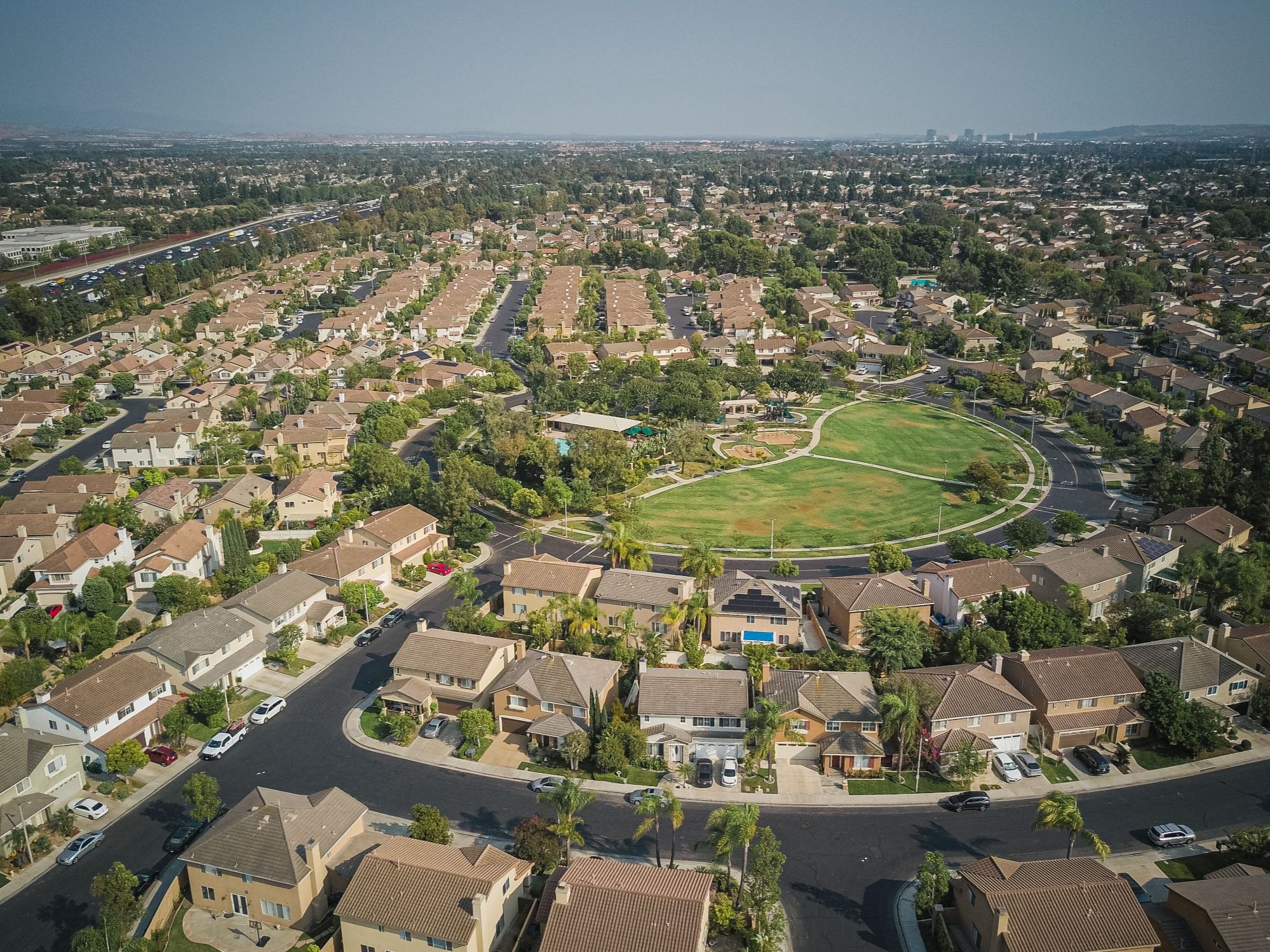
Aerial view of a suburban neighborhood built around a central park. Photo: Pexels.
Two Loan Estimates land in your inbox on the same afternoon, one for a loan backed by the U.S. Department of Veterans Affairs (VA) and one insured by the Federal Housing Administration (FHA), and the monthly payments sit closer together than anyone at your last base said they would. Your report date to Joint Base San Antonio (JBSA) is a few weeks out, and now you're second-guessing whether the benefit you earned is the right tool for this purchase.
Weighing a VA loan vs. FHA loan in San Antonio comes down to who qualifies, what each program charges upfront and every month, and how each one treats the house you want. I'm Anthony Sharp, a U.S. Air Force veteran and REALTOR® with Sharp Realty Group in Cibolo. During nine years in uniform, I made five permanent change of station (PCS) moves, so I know how fast these decisions stack up.
The right answer changes from one household to the next. A junior airman with full entitlement, a dual-income family where only one spouse is eligible, and a veteran who kept a first home as a rental can each land on a different loan. Before you commit to a VA loan in San Antonio, it helps to see where FHA might serve your household better and where it won't.
How VA and FHA Loans Work for San Antonio Buyers
Both programs exist to make homeownership reachable with little cash down, but they're built for different buyers and follow different rules:
Government Backing and Lender Overlays
VA doesn't lend the money on most purchases. It guarantees part of a private lender's loan, which is why lenders can offer zero down without monthly mortgage insurance. FHA insures the lender against loss instead and charges the borrower mortgage insurance to pay for it.
Each program sets minimum rules, and lenders often add stricter ones on top, called overlays. That's why two lenders can give you different answers on the same file, and why it pays to shop more than one lender.
Service and Borrower Eligibility
VA eligibility runs on service history. Current service members generally qualify after 90 continuous days of active duty, veterans who served from August 2, 1990, onward generally need 24 continuous months or the full period they were called up for (at least 90 days), and National Guard and Reserve members can qualify with six creditable years or qualifying active-duty time. Certain surviving spouses qualify too. Your Certificate of Eligibility (COE) proves it to a lender, and VA reviews special cases individually, so treat these minimums as a general guide that VA can update.
FHA has no service requirement. Any buyer who meets the credit, income, and occupancy standards set by the U.S. Department of Housing and Urban Development (HUD) and the lender can use it.
Property Types and Occupancy
Both loans are built for a primary residence. Each can finance a single-family home, an approved condo, or a property with up to four units, as long as you live in one of them. FHA generally expects at least one borrower to move in within 60 days of closing and live there for at least a year, and VA likewise requires you to live in the home.
Neither program will finance a pure investment property or a vacation home. Occupancy rules carry exceptions and can change, so confirm your situation with your lender before you write an offer.
VA Loan vs. FHA Loan Costs for JBSA Buyers in 2026

Going over paperwork at the table before signing. Photo: Pexels.
Interest rates get most of the attention, but the bigger cost gaps between these loans sit in charges that never show up in a rate quote:
| Feature | VA Loan | FHA Loan |
|---|---|---|
| Minimum down payment | 0% with full entitlement | 3.5% with a 580 score, 10% with 500 to 579 |
| Upfront fee | Funding fee of 2.15% on first use with less than 5% down | Upfront mortgage insurance premium (MIP) of 1.75% of the base loan |
| Monthly mortgage insurance | None at any down payment | Annual MIP, commonly 0.55% at 3.5% down |
| Insurance duration | Not applicable | Life of the loan with less than 10% down, 11 years at 10% or more |
| Seller concessions | Normal closing costs uncapped, other concessions up to 4% | Up to 6% of the sales price |
| Loan limit | None with full entitlement | County limits, with a $541,287 one-unit floor |
| Disability waiver | Funding fee waived for eligible veterans | No equivalent waiver |
These figures reflect rules published for 2026 by VA and HUD, and either agency can change them at any time. Lenders may also apply stricter standards, so treat the table as a general guide and confirm current terms with a licensed lender.
Cash to Close
Zero down is the headline VA advantage, and it is real money. On a $350,000 home, the FHA 3.5% minimum works out to $12,250 before closing costs, while a VA buyer with full entitlement may bring nothing toward a down payment. Both buyers still need earnest money, an option fee, inspection costs, and prepaid taxes and insurance, so zero down rarely means zero cash.
VA also doesn't let you roll closing costs other than the funding fee into a purchase loan, which makes seller credits especially useful on that side. These figures are an illustration only, and your lender's Loan Estimate is the number to plan around.
Upfront Fees
On that same $350,000 purchase, first-time VA use with no down payment adds a 2.15% funding fee, about $7,525, which most buyers finance into the loan. The FHA buyer's base loan of $337,750 picks up a 1.75% upfront MIP, about $5,911, also usually financed. Repeat VA users pay 3.3% with less than 5% down, which narrows the gap, and a down payment of 5% or more brings the funding fee down for anyone.
Check your COE for an exemption before you budget around the VA funding fee chart. Veterans who receive compensation for a service-connected disability pay no funding fee at all, and neither do certain surviving spouses or active-duty Purple Heart recipients. VA sets these exemptions and can revise them, so confirm your status before closing.
Monthly Mortgage Insurance
This is where VA usually pulls ahead. An FHA buyer putting 3.5% down on a 30-year loan typically pays annual MIP of 0.55%, collected monthly, which comes to roughly $155 a month on that $337,750 base loan in the first year. With less than 10% down, that premium stays for the life of the loan, and the common way out is refinancing once you have enough equity. Put 10% or more down and the annual premium drops off after 11 years.
A VA loan carries no monthly mortgage insurance at any down payment. In this illustration, an FHA buyer could pay more than $5,000 in premiums over a typical three-year tour, a cost the VA buyer never sees. HUD sets these premium rates and has changed them before, so confirm the current schedule with your lender.
Seller Concessions
The San Antonio Board of REALTORS® reported about six months of inventory in September 2026, with homes averaging close to three months on the market, so many sellers are more open to paying toward a buyer's costs. Market conditions shift month to month, so check the latest numbers before you write an offer. FHA lets a seller contribute up to 6% of the sales price toward closing costs, prepaid items, and discount points. VA doesn't cap the seller's payment of normal closing costs, but it limits other concessions, such as paying the funding fee, prepaying insurance, or paying off a buyer's debt, to 4% of the home's reasonable value.
In practice, either program can leave room to negotiate a rate buydown or a large share of your closing costs, depending on the seller, the appraisal, and your lender's rules.
Buyers who tour 3113 Cameron Riv in Schertz, a five-bedroom home in Fairway Ridge, will find a seller ready to contribute toward closing costs or a rate buydown, with VA and FHA both accepted, though terms like these can change while a home is on the market.
Credit, Income, and Appraisal Rules for VA and FHA Loans
Cost is only half the comparison. Getting approved comes down to three checkpoints, and VA and FHA handle each one a little differently:
Credit Standards
VA doesn't set a minimum credit score of its own, so the cutoff comes from your lender, and many lenders look for a score somewhere in the 580 to 620 range. FHA does publish minimums. A score of 580 or higher qualifies for the 3.5% down payment, scores from 500 to 579 require 10% down, and many FHA lenders set higher minimums of their own. HUD and individual lenders can revise these thresholds at any time.
Since a few points can change your rate, pull your own reports and dispute any errors as you sort through the VA loan credit score requirements each San Antonio lender sets.
Income Standards
Both programs look at your debt-to-income (DTI) ratio, which compares your monthly debts to your income. VA doesn't set a strict debt threshold, but many lenders prefer a DTI of 41% or less on a VA loan. FHA can stretch further, sometimes to 50% or more, depending on the lender and the strength of the rest of your file.
For service members, lenders can count your Basic Allowance for Housing (BAH) toward the income you qualify with, which can make a difference on a single income. Underwriting standards vary by lender and change with program updates, so get your numbers from a licensed loan officer rather than an online calculator.
Appraisal Standards
Both programs send an appraiser to set the value and look at whether the home is safe and livable. On a VA loan, a VA-certified appraiser issues a Notice of Value and checks the home against VA's Minimum Property Requirements, often flagging items like peeling paint, missing handrails, or broken windows. An FHA appraisal also checks the home against minimum property standards, so a house in sound condition tends to make either loan easier.
When a VA appraisal is trending below the contract price, the Tidewater process may give your agent a short window to submit comparable sales before the value is final. Should the value still come in low, your options include renegotiating the price, paying the difference in cash, or canceling under the VA escape clause with your earnest money returned. Flagged repairs usually need to be completed and checked again before you can close, and appraisal rules can change, so lean on your lender and agent for the current process.
When an FHA Loan Can Make More Sense Near JBSA
For most eligible buyers, VA comes out ahead on cost. A few situations can flip the math or take VA off the table entirely:
Buying Without VA Eligibility
A civilian spouse buying in their own name, a Department of Defense civilian transferring to JBSA-Randolph or JBSA-Fort Sam Houston, or a service member who hasn't reached the minimum service time can't qualify for VA financing on their own. For these buyers, FHA is often the low-down-payment option that fits, since it's open to anyone who meets its credit, income, and occupancy standards.
Buyers with stronger credit and some savings should still price a conventional loan, since conventional mortgage insurance can usually be removed once you reach enough equity, while FHA's often stays for the life of the loan. Removal rules depend on your loan and servicer, so ask your lender how they apply to you.
Keeping a First VA Home as a Rental
Hold onto your last VA-financed home after a PCS, and part of your entitlement stays attached to that loan. You may still have enough remaining entitlement to buy with zero down at San Antonio price points, since VA measures it against the 2026 county conforming limit of $832,750, but the math gets specific fast and sometimes calls for a down payment. VA sets the entitlement rules and can change them, and each lender runs its own calculation.
I own and self-manage rental homes in the Cibolo-Schertz corridor, so I understand the pull to hold onto a property. That's why I run the entitlement numbers with clients up front, before they choose between a second VA loan and an FHA loan. FHA can make sense here because it leaves your remaining VA entitlement untouched.
Saving the VA Benefit for a Later Move
Some buyers hear they should save their VA benefit for a bigger purchase down the road. With full entitlement, VA has no loan limit, and you can typically restore entitlement after you sell the home and pay off the loan. Paying FHA mortgage insurance for years to protect a benefit you can usually reuse rarely pencils out.
The exception is a buyer who plans to keep this home as a rental and wants more entitlement free for a higher-cost duty station later. That trade-off deserves a side-by-side with your lender, since restoration rules can change before your next orders.
Before you tour 103 Chadwick Dr in San Antonio's Valley Hi, it helps to know the listing accepts both VA and FHA, so either loan can work on this single-story 1963 ranch a few minutes from JBSA-Lackland. Confirm current terms before you schedule, since listing details can change.
Using a VA or FHA Loan Through Your JBSA PCS
A Home for Sale sign in front of a single-story home. Photo: Pexels.
Orders don't wait for underwriting, so the loan you choose has to fit the calendar as well as the budget. Each stage of the move, from the first quote to your next set of orders, puts the loan to a different test:
Preapproval Planning
Ask one lender to price a VA scenario and an FHA scenario on the same day, using the same assumptions, so you compare the full monthly payment and cash to close rather than a single rate. The Freddie Mac 30-year fixed average was 7.32% as of October 22, 2026, but that benchmark tracks conventional loans, rates move week to week, and each lender prices VA and FHA rates separately. Having these documents ready usually speeds up either file.
- Your COE, or a statement of service if you're on active duty
- Your two most recent Leave and Earnings Statements (LES) or pay stubs
- Your W-2s or federal tax returns from the past two years
- Your bank statements from the past two months for every account
- Your DD214 if you've separated or retired
- Your VA disability award letter if you receive compensation
Document requirements vary by lender and loan program, so treat this list as a general guide.
Offer Strategy
Some sellers still hesitate over VA and FHA offers because of the appraisal requirements, especially when several offers are on the table. I address those concerns early with a solid preapproval and a realistic closing date. With many homes taking longer to sell, a well-prepared VA or FHA offer can compete, though every seller decides for themselves.
Texas Veteran Programs
Texas adds a state-level option through the Texas Veterans Land Board (VLB). Its home loan program works alongside VA, FHA, or conventional financing through a participating lender, and veterans with a service-connected disability rating of 30% or higher may qualify for a discounted interest rate.
VLB eligibility rules, rates, and loan amounts are set by the state and change periodically, so ask your lender whether you qualify and how the VLB rate compares with a standard VA or FHA quote.
Resale Options
When your next orders arrive, a VA loan gives you one more option at resale. Another buyer, whether or not they served, may qualify to take over your loan and keep your rate, which can stand out when today's rates run higher. VA charges a 0.5% funding fee on an assumption, and your entitlement generally stays with the loan unless the person assuming it is an eligible veteran who uses their own entitlement in its place.
Offering a VA loan assumption to San Antonio buyers starts with a call to your lender and servicer, since approval depends on their rules at the time.
Touring 672 Planters Pass in Schertz with a preapproval already in hand puts you in position to move on a four-bedroom Kramer Farm home a few minutes from Randolph. It has a 2022 roof, Schertz-Cibolo-Universal City Independent School District zoning, and its listing accepts both VA and FHA as of this writing.
Choosing Your San Antonio Home Loan With Confidence

A family carrying moving boxes into their new home. Photo: Pexels.
Those two Loan Estimates should read differently to you now. The gap between them comes down to eligibility, the funding fee against FHA mortgage insurance, and how long you expect to own the home. Once those pieces are on the table, the right loan for your household tends to make itself clear.
You don't have to sort it out alone from another time zone, either. Working with a Military Relocation Professional (MRP) in San Antonio who has carried a set of orders means your loan choice, your report date, and your home search can move on one plan instead of three.
Whether VA wins on your numbers or FHA turns out to be the cleaner fit, you can walk into your house-hunting trip knowing exactly why you chose it, and that clarity carries all the way to the closing table.
Ready to Compare Your VA and FHA Options?
I'm Anthony Sharp with Sharp Realty Group, a U.S. Air Force veteran who helps military families and relocating buyers match the right financing to the right home across San Antonio, Schertz, Cibolo, and the wider JBSA area. When you want a second set of eyes on two Loan Estimates or a plan built around your report date, let's talk.
Call or text: 210-997-0763
Schedule a time: book a consultation
Email: anthony@sharprealtygrouptx.com
Office: 213 Terramar, Cibolo, TX 78108
Frequently Asked Questions (FAQs)
Is a VA loan always better than an FHA loan for JBSA buyers?
Not always, though it usually costs less for eligible buyers. FHA can be the better fit when you aren't VA-eligible or your entitlement is still attached to a rental. A lender can price both side by side so you see the difference in dollars.
Can I use an FHA loan even if I qualify for a VA loan?
Yes. Being VA-eligible doesn't require you to use the benefit, and some buyers choose FHA or conventional financing instead. Run both scenarios with a licensed lender before deciding.
Are VA appraisals harder to pass than FHA appraisals?
Both look at value along with safety and livability, and VA appraisers are known for flagging items like peeling paint and missing handrails. A home in sound condition tends to clear either appraisal with fewer surprises, though appraisal standards are set by each agency and can change.
Can my spouse buy a home near JBSA with an FHA loan?
Yes. A civilian spouse can apply for an FHA loan on their own by meeting the credit, income, and occupancy requirements set by HUD and the lender. With the eligible service member on the loan, a VA loan is also an option. Your lender can show which structure gives you the more comfortable payment.
Do lenders count BAH as income for VA and FHA loans?
On a VA loan, lenders can count BAH toward the income you qualify with, and your lender can tell you how it's handled on an FHA loan. Bring your recent LES and confirm the numbers during preapproval.
How long does it take to close a VA or FHA loan in San Antonio?
There's no fixed timeline. It depends on the lender, the appraisal, any repair items, and how quickly documents come back, so ask your lender for an estimate based on your file. At Sharp Realty Group, we set the contract dates around your report date from the first conversation.
* * *
Disclaimer: This article is general information only and does not consider your individual financial, tax, or legal circumstances. Mortgage rates, VA and FHA program rules, funding fees, mortgage insurance premiums, and loan limits change and are provided as a general guide, not a guarantee. Nothing here guarantees financing, approval, appreciation, or resale value. Before making a decision, speak with a qualified professional such as a REALTOR®, a licensed lender, or an attorney about your specific situation.
Categories
- All Blogs (285)
- BAH (4)
- For Home Buyers (199)
- For Home Sellers (93)
- For Investors (45)
- For Military Service Members (190)
- For Renters (10)
- JBSA (7)
- Local Events (12)
- Local Real Estate News (40)
- Market Updates (43)
- Military Relocation (42)
- Neighborhood Tours (58)
- PCS Move (111)
- Property Tours (7)
- VA Loans (16)
Recent Posts