

Move-In Ready vs Fixer Upper: San Antonio 2026
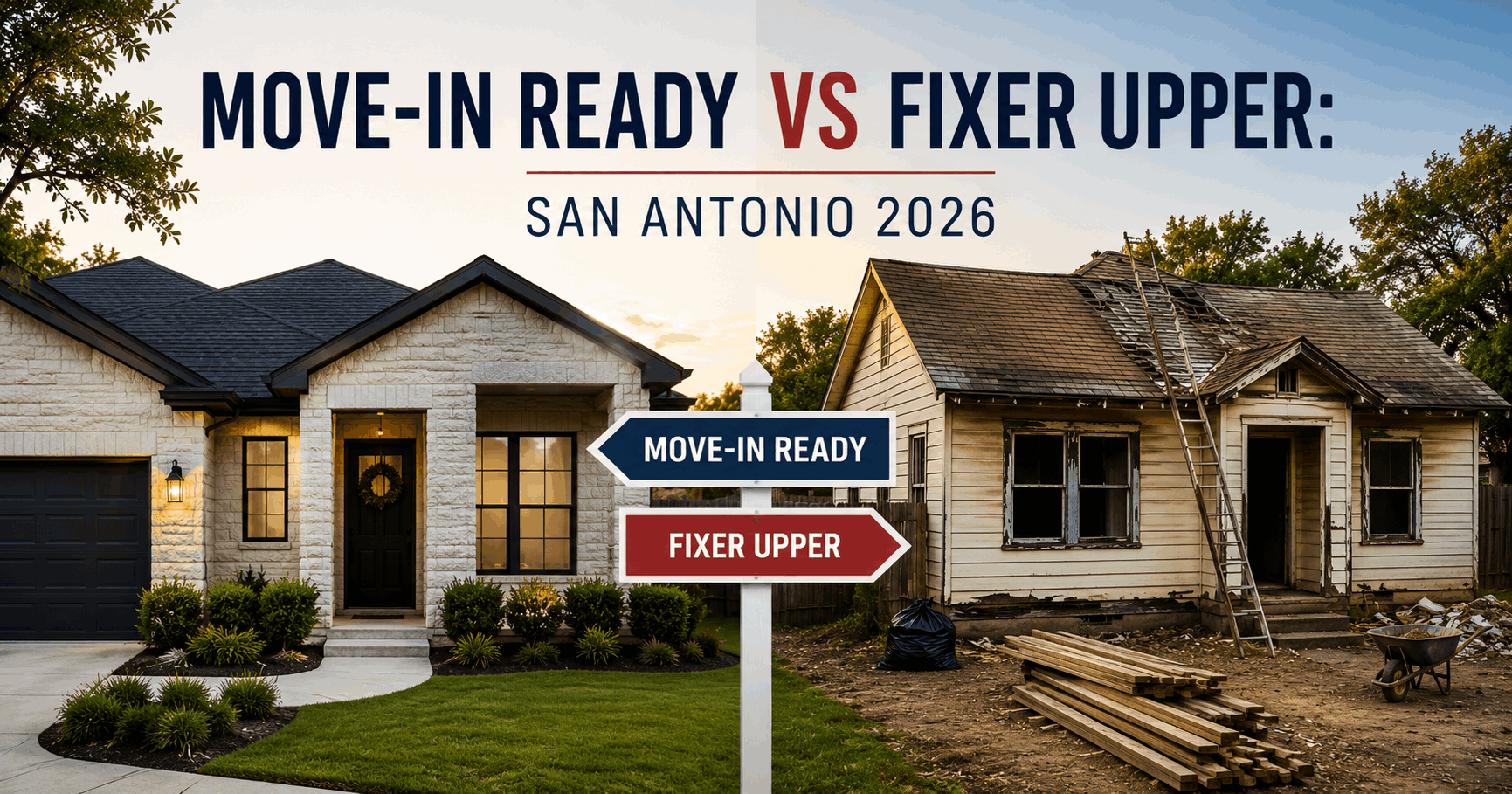
You find two homes in the same price range near Joint Base San Antonio (JBSA), one turnkey and one that needs a kitchen, flooring, and a new roof, and the fixer looks like the deal until you try to guess what the repairs will actually run. Choosing move-in ready vs a fixer upper in San Antonio is one of the hardest calls a buyer makes in 2026, because a slower market and higher repair costs have widened the gap between the two paths in ways that are easy to miss on a first walkthrough.
I am Anthony Sharp, a U.S. Air Force veteran and REALTOR® with Sharp Realty Group here in Cibolo, and this is the decision I talk through with buyers almost every week across the northeast San Antonio corridor. Before you tour a single one of the San Antonio homes for sale, it helps to run the real numbers on each path instead of the ones the listing photos suggest. I own and self-manage rental properties, so I have paid for more roofs, water heaters, and surprise repairs than I care to count, and that experience shapes how I coach clients through this choice.
The honest answer is that neither option wins on its own. A move-in ready home can be worth every dollar of its higher price, and a fixer upper can be a smart way to build equity, but only if you price the work correctly and know how your financing handles it. I want to walk you through the tradeoffs the way I would at the kitchen table, so you can decide which one fits your budget, your timeline, and your tolerance for a project.
Key Takeaways
- A move-in ready home costs more up front but removes the guesswork on repairs, which matters when rates and repair labor are both elevated in 2026.
- A fixer upper can build equity, but San Antonio buyers routinely underestimate repair costs, and a bad estimate erases the discount.
- VA and conventional buyers face different rules on homes that need work, so confirm your financing path before you fall for a project.
- The slower 2026 market gives buyers real negotiating room on both paths through concessions, credits, and price adjustments.
Why Home Condition Matters More in the 2026 San Antonio Market
A few years ago buyers overlooked worn carpet and dated kitchens just to win a home. That is not the market we are in now, and the shift changes how much a home's condition should weigh on your decision. Here is what is driving it:
More Inventory and Longer Days on Market
The San Antonio market has moved toward balance. The San Antonio Board of REALTORS (SABOR) reported months of inventory around 5.5 in early 2026, near what economists consider a balanced market, and homes were averaging roughly 98 days on market, up meaningfully year over year. More choices and slower sales mean you are no longer forced to accept a home's flaws to beat other offers. You can compare a turnkey home and a fixer side by side and let the numbers, not the competition, drive the call.
Elevated Rates and Repair Costs
The Freddie Mac 30-year fixed averaged 6.58% as of July 23, 2026, and repair labor and materials have stayed high across Texas. That combination squeezes buyers from both ends. A higher payment leaves less monthly room for a renovation, and a bigger repair bill after closing hits harder when your cash reserves already went toward the down payment and closing costs. Condition matters more in 2026 precisely because the cushion is thinner.
The Widening Gap Between Seller and Buyer Repair Math
Buyers and sellers price repairs very differently, and that gap decides whether a fixer is an opportunity or a trap. A seller may see $5,000 of carpet, while the buyer stacks carpet, paint, a dated kitchen, and whatever the inspection turns up, then discounts the home by far more. When a cost is uncertain, buyers assume the worst, so how accurately you scope the work is what tips the deal one way or the other.
What Move-In Ready Really Means for San Antonio Buyers
Move-in ready does not mean brand new or flawless. It means you can close, unpack, and live without a project list hanging over you. For most of my buyers, that translates to a specific set of conditions:
The Features That Define Turnkey
A home most buyers would call move-in ready usually checks these boxes:
- Major systems, meaning the roof, heating and cooling, water heater, plumbing, and electrical, are functional and reasonably current.
- Flooring and paint are in good, neutral condition rather than worn or heavily personalized.
- The kitchen and bathrooms are usable as-is, even if not recently remodeled.
- There are no obvious safety or habitability red flags waiting on the inspection.
- Curb appeal and landscaping are maintained rather than neglected.
That list is a general guide, and every home is different, so lean on your inspection rather than a listing description to confirm condition.
The Buyers Turnkey Suits
Turnkey homes tend to fit buyers on a tight timeline or a tight cash position after closing. Military families arriving on a permanent change of station (PCS) with a firm report date rarely have weeks to manage contractors, and a move-in ready home removes that risk. The same is true for busy professionals, first-time buyers without a repair reserve, and anyone relocating from out of state who cannot supervise work from a distance. You pay more for the certainty, but for many buyers that certainty is the point.
The Premium You Pay for Convenience
The tradeoff is straightforward. Move-in ready homes usually carry a firmer price and less negotiating room on the number itself, though in the current market you may still capture seller concessions toward closing costs or a rate buydown. You are paying a premium to skip the project, and whether that premium is worth it depends on how much the comparable fixer would truly cost to bring up to the same standard.
What a Fixer Upper Actually Costs in San Antonio in 2026

This is where buyers get into trouble, because the purchase discount is visible and the repair bill is not. A fixer only makes sense when you scope the work with real numbers, not optimism. Here is how I help buyers pressure-test that math:
Budgeting the Repairs Honestly
Texas repair costs have climbed, and small projects add up fast. A standard kitchen remodel in Texas has been running in the range of roughly $28,000 for a mid-size job, and a bathroom can span anywhere from a few thousand dollars for a light refresh to well over $30,000 for a full gut, depending on scope and finishes. Roofs, heating and cooling systems, foundation work, and electrical or plumbing updates are the big-ticket items that can quietly turn a bargain into a break-even. I always tell buyers to get written contractor bids during the option period rather than guessing, because a rough mental estimate is almost always low.
The categories I watch most closely on a corridor fixer tend to sort into a short list:
- Structural and safety items like foundation movement, roof age, and drainage, which cost the most to correct and matter most to lenders.
- Mechanical systems, meaning heating and cooling, water heaters, and electrical panels, which wear out on a schedule and are expensive to replace at once.
- Cosmetic updates such as paint, flooring, fixtures, and cabinets, which buyers notice first but usually make up the cheaper share of the budget.
- Code or permit surprises, which can appear once walls are opened and are nearly impossible to price before work starts.
Treat that list as a general guide and let a licensed inspector and contractor put real figures on your specific home.
Understanding Renovation Return
Not every dollar you spend comes back at resale. The 2026 Cost vs Value data continues to show that smaller, cosmetic, and exterior projects return more at resale than large interior remodels. Minor kitchen updates, fresh paint, flooring, and curb-appeal work tend to recover a healthy share of what you put in, while high-end gut renovations often recover less than half. If you are buying a fixer partly as an investment, that pattern matters. Refreshing tends to beat rebuilding when the goal is resale value rather than a personal wish list.
Factoring In Time, Stress, and Carrying Costs
A renovation is not only money, it is time and disruption. While the work happens you may be paying a mortgage on a home you cannot fully use, or covering both a rental and the new loan. Permits, contractor availability, and hidden damage behind the walls can all stretch the timeline. As someone who has managed repair projects on my own rentals, I can tell you the schedule almost always runs longer than the first estimate. Build a contingency into both your budget and your calendar before you commit.
Knowing When a Fixer Is the Sharper Play
A fixer can absolutely win when the discount is larger than the honest, bid-based repair cost, when you have cash reserves beyond your down payment, and when you plan to stay long enough to enjoy the equity you create. Buyers who are comfortable managing contractors, who want to personalize a home, or who are hunting in an established neighborhood where turnkey inventory is scarce often do well with a project home. Either way, the decision rests on written numbers, not on the pull of a low list price.
How Your Financing Changes the Move-In Ready vs Fixer Upper Decision
Here is the part buyers near JBSA most often overlook. The loan you use can quietly rule a fixer in or out before you ever negotiate price, so line up your financing before you tour project homes:
Buying a Fixer With a VA Loan
A standard U.S. Department of Veterans Affairs (VA) loan requires the home to meet the VA Minimum Property Requirements (MPRs) for safety, soundness, and sanitation before closing. Those standards are spelled out on the federal VA home loan programs page, and a home with a failing roof, exposed wiring, or major system problems may not pass as-is, which means the seller or a negotiated credit has to resolve those items first. For homes that need more than cosmetic work, the VA renovation loan, sometimes called a VA rehab loan, lets eligible buyers roll the purchase price and approved repairs into one zero-down loan, typically up to around $50,000 in repairs depending on the lender. Fewer lenders offer it and the process runs longer, so confirm your lender handles it early. Before you weigh a renovation loan against a turnkey purchase, it helps to see how your VA loan works near Randolph from eligibility through closing.
Buying a Fixer With Conventional or Other Financing
Conventional buyers have their own renovation options, and standard loans are generally more forgiving of cosmetic issues than VA financing, though lenders still care about major health and safety items. Renovation loan products exist on the conventional side as well, allowing you to finance improvements based on the home's projected value after repairs. The right structure depends on your credit, your down payment, and the scope of work, so this is a conversation for a licensed lender rather than a rule of thumb. Loan terms and program details change, so confirm the current options with your lender before you write an offer.
Closing on a Move-In Ready Home Cleanly
A turnkey home that already meets property standards is the cleanest path through underwriting and appraisal, which is one reason move-in ready homes appeal so strongly to buyers on a PCS clock. There is no renovation escrow to manage, no contractor bids to submit, and less risk of an appraisal flagging a required repair that stalls your closing. When your timeline is tight, that simplicity has real value beyond the home itself.
Negotiating Either Path in a Slower San Antonio Market
The balanced 2026 market hands buyers leverage on both a turnkey home and a fixer, and how you use that leverage differs by path. Here is where I focus buyers:
Leverage on a Move-In Ready Home
Even on a well-kept home, longer days on market give you room to ask. Sellers who have watched their listing sit are often open to closing-cost credits, a rate buydown, or a modest price adjustment, especially above the entry-level price tiers where inventory is heaviest. The home may be turnkey, but the terms are still negotiable. That leverage plays out differently street by street, which is why it pays to know what six months of inventory really means for Cibolo and Schertz buyers before you make an offer.
Leverage on a Fixer Upper
On a home that needs work, your inspection is your strongest tool. Once you have written repair costs, you can negotiate a lower price, a repair credit, or specific repairs completed before closing. Sellers of project homes generally expect a discount for condition, so the question is whether you can get the discount to fully cover the work, the risk, and the time. Do not assume a low list price already accounts for everything, because it rarely does. Review the seller's disclosure and your inspection report carefully before you treat a fixer as a bargain.
Leverage Lost to the Cheapest Sticker
The cheapest home on the block is not automatically the smartest buy. I have walked buyers away from a low-priced fixer once the bids came in. On one corridor project home the discount looked generous until a roof, a heating and cooling replacement, and foundation work got priced out, and a turnkey home two streets over came in lower on total cost. The goal is not the cheapest sticker, it is the smallest true cost once condition, repairs, and financing all sit in the same equation. That is the comparison I run with every buyer weighing these two paths.
Making the Right Call on Your San Antonio Home
The two listings that felt impossible to compare should feel clearer now, because you know the fixer's real cost is the purchase price plus honest, bid-based repairs plus the time and stress of the project, while the move-in ready home's higher price is buying you certainty and a clean closing. Neither is the right answer for everyone. The right answer is the one where the full math, not the listing photos, points in your favor.
You do not have to guess your way through it. Get your financing lined up so you know which path your loan even allows, use the option period to turn repair guesses into written numbers, and lean on the negotiating room this market gives you on either home. When you line up price, repairs, financing, and timeline side by side, the decision between move-in ready and a fixer upper tends to make itself, and you can move at the pace that fits your life rather than a listing agent's timeline.
Ready to Weigh Your Move-In Ready and Fixer Options?
I am Anthony Sharp with Sharp Realty Group, a U.S. Air Force veteran and military relocation specialist who helps buyers and military families across San Antonio, Cibolo, Schertz, and the JBSA corridor decide between turnkey homes and fixer uppers with real numbers. If you want a second set of eyes on a fixer's repair math or a plan that fits your PCS timeline, let's talk.
Call or text: 210-997-0763
Schedule a time: book a consultation
Email: anthony@sharprealtygrouptx.com
Office: 213 Terramar, Cibolo, TX 78108
Frequently Asked Questions (FAQs)
Is a move-in ready home worth the higher price in San Antonio?
Often, yes, if the price premium is smaller than what a comparable fixer would truly cost to renovate. Move-in ready homes remove repair guesswork, close cleanly, and let you settle in without a project, which is valuable when rates and repair costs are both elevated. The honest test is comparing total landed cost, not just the two list prices.
Can I buy a fixer upper with a VA loan near JBSA?
Yes, through two paths. A standard VA loan works on a home needing only minor fixes as long as the property meets VA Minimum Property Requirements before closing. For homes needing more work, a VA renovation loan can roll purchase and approved repairs into one zero-down loan, usually up to around $50,000 in repairs. Fewer lenders offer the renovation product, so confirm yours does before you tour project homes.
How much do repairs actually cost on a San Antonio fixer upper?
It varies widely by scope. A mid-size kitchen remodel in Texas has been running around $28,000, and bathrooms range from a few thousand dollars for a refresh to well over $30,000 for a gut. Big-ticket items like roofs, heating and cooling systems, and foundation work can dwarf cosmetic budgets. Always get written contractor bids during your option period rather than estimating in your head. These figures are a general guide and change over time.
Do fixer uppers get a bigger discount in the 2026 market?
They can. With more inventory and homes sitting longer, sellers of project homes generally expect to negotiate on condition. Your inspection and written repair estimates are the leverage. The caution is that a low list price rarely accounts for every repair, so confirm the discount fully covers the work, risk, and time before assuming it is a bargain.
Which is better for a military family on a PCS timeline?
For a tight PCS timeline, move-in ready is usually the lower-risk choice because it closes cleanly and does not require managing contractors from a distance or supervising work before your report date. A fixer can still work if you have time, reserves, and a renovation loan lined up, but the schedule risk is real when your orders will not wait.
Should I get an inspection on a home that is already move-in ready?
Yes. A home that looks turnkey can still hide an aging roof, a tired heating and cooling system, or drainage issues. An inspection protects you either way and can surface items worth negotiating even on a well-kept home. Skipping it to save a few hundred dollars is a risk I steer my buyers away from on any purchase.
* * *
Disclaimer: This article is general information only and does not consider your individual financial, tax, or legal circumstances. Market data, mortgage rates, loan program terms, and repair costs change and are provided as a general guide, not a guarantee. Nothing here guarantees financing, approval, appreciation, or resale value. Before making a decision, speak with a qualified professional such as a REALTOR®, a licensed lender, or an attorney about your specific situation.
Categories
- All Blogs (285)
- BAH (4)
- For Home Buyers (199)
- For Home Sellers (93)
- For Investors (45)
- For Military Service Members (190)
- For Renters (10)
- JBSA (7)
- Local Events (12)
- Local Real Estate News (40)
- Market Updates (43)
- Military Relocation (42)
- Neighborhood Tours (58)
- PCS Move (111)
- Property Tours (7)
- VA Loans (16)
Recent Posts