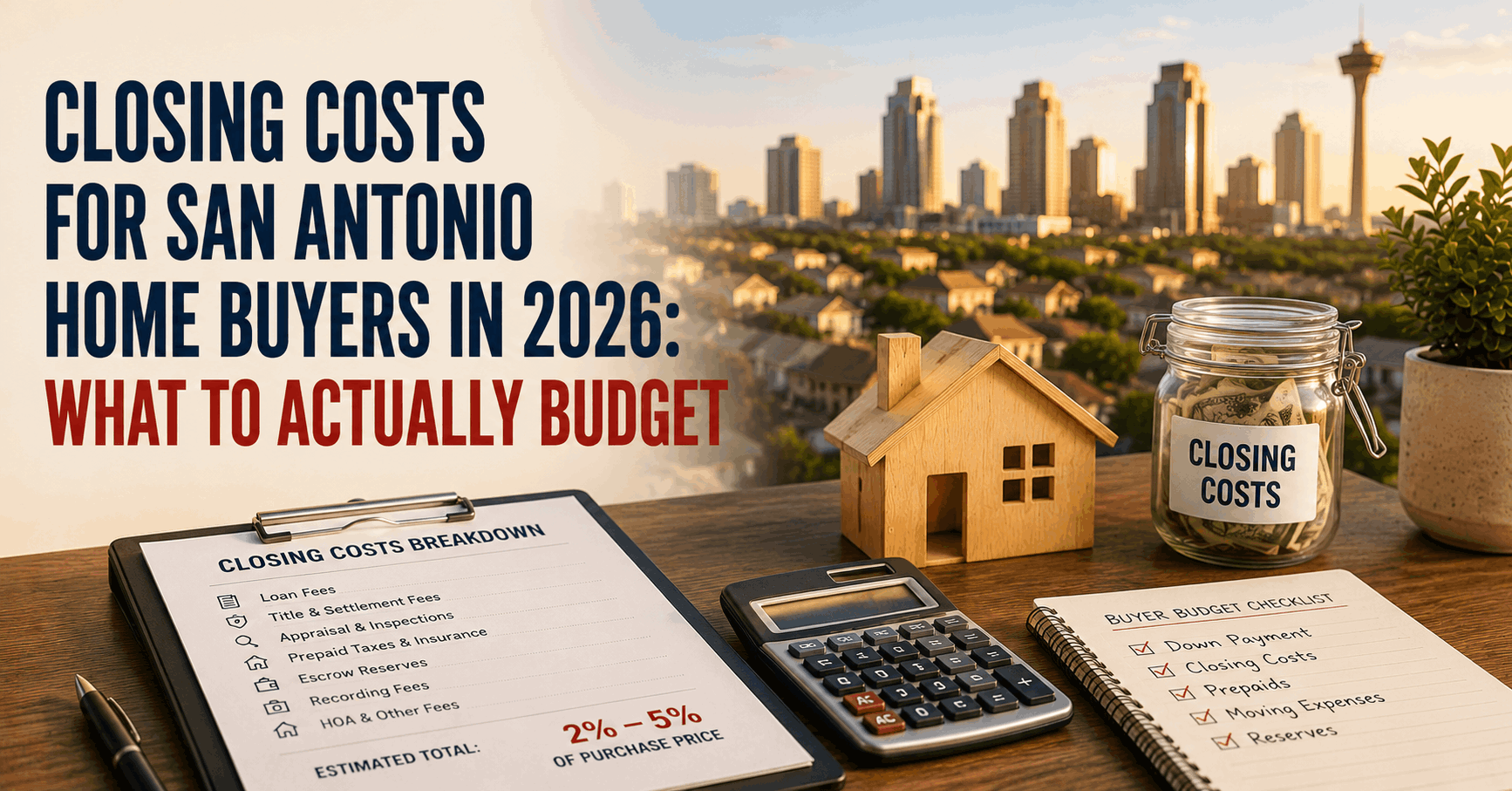
Closing Costs for San Antonio Home Buyers in 2026: What to Actually Budget
You saved for months to hit your down payment, your offer got accepted on a house in San Antonio, and then the lender sends over a Loan Estimate with a cash-to-close number that lands a few thousand dollars higher than you planned. That gap is closing costs, and it catches more first-time and relocating buyers off guard than almost anything else in the transaction.
I am Anthony Sharp, a U.S. Air Force veteran and REALTOR® with Sharp Realty Group here in Cibolo, and closing costs are the conversation I have on nearly every first call. Buyers ask about the rate and the price, then go quiet when I bring up the fees, prepaids, and escrows that show up at the table on top of the down payment.
Once you know the line items, you stop being surprised and start negotiating. Before you tour the San Antonio homes for sale that fit your budget, it pays to see what these costs are, what they run in 2026, and where you can shift some of them onto the seller.
This is the same breakdown I walk buyers through across San Antonio, Cibolo, Schertz, and the wider northeast San Antonio corridor, with the local details that shape the number you write a check for.
Key Takeaways
- Buyer closing costs in San Antonio typically run about 2% to 5% of the purchase price, separate from your down payment.
- Texas cut title insurance premiums by 6.2% effective March 1, 2026, which trims one fixed piece of the bill.
- Prepaid property taxes and escrow reserves are often the largest line, and Bexar County tax rates drive them higher.
- In today's slower market, sellers are frequently paying part of your closing costs through negotiated concessions.
What Closing Costs Actually Cover for San Antonio Buyers

Closing costs are not one fee. They are a stack of separate charges from your lender, the title company, the county, and the parties who verify the home is worth what you are paying. Grouping them makes the total far less intimidating:
Lender and Loan Fees
These are the charges tied to originating your mortgage. Depending on your loan and lender, they can include an origination or underwriting fee, a credit report fee, and any discount points you choose to buy to lower your rate. On many San Antonio loans, the origination piece runs around 1% of the loan amount or less, though it varies by lender and product. This is the category where shopping more than one lender pays off, because these fees are not fixed and the difference between quotes can be real money.
Title and Settlement Charges
Title work protects your ownership and your lender's lien against claims that predate your purchase. In Texas, the owner's title policy premium is set by the state, so every title company charges the same rate for the same coverage, and that rate dropped 6.2% on March 1, 2026. On a $300,000 home, the owner's policy premium is roughly $1,852 under the new schedule, and a $400,000 home runs closer to $2,264. The premium itself is not negotiable, but the escrow and closing fees a title company adds on top of it can vary, so those are worth comparing.
Third-Party and Inspection Fees
Before your lender funds the loan, an appraiser confirms the home's value, and you will want an inspector to confirm its condition. A single-family appraisal in the San Antonio market commonly falls in the low hundreds of dollars, and a general home inspection is a separate out-of-pocket cost you pay during the option period. I never let a client skip the inspection to save a few hundred dollars, because I own and manage rental properties myself, and I have seen what a missed roof or foundation issue costs on the back end compared to the price of catching it up front.
Government Recording Fees
Bexar, Guadalupe, and Comal counties charge modest fees to record the deed and mortgage in the public record. Texas has no state real estate transfer tax, which is one reason our closing costs land below the national average even with higher property taxes. Recording fees are small relative to the rest of the stack, but they belong on the list so nothing on your final statement reads as a surprise.
Prepaid Insurance and HOA Dues
Your first year of homeowners insurance is typically paid at closing, and your lender also collects a few months of it into escrow alongside taxes. Texas premiums have climbed in recent years, so this line is larger than many buyers expect, and it is worth getting an insurance quote early rather than at the last minute. If the home sits in a community with a homeowners association, which is common across newer Cibolo and Schertz subdivisions, you may owe a prorated share of dues plus a one-time transfer or capitalization fee. I always ask for the HOA documents up front so a buyer sees those numbers before they matter.
These categories and figures are a general guide for 2026 and vary by lender, title company, county, and loan type. Your binding numbers come from the Loan Estimate and Closing Disclosure your lender provides.
How Much Closing Costs Run in San Antonio in 2026
The percentages get thrown around loosely online, so I like to ground them in a real purchase price. For most San Antonio buyers, closing costs land somewhere between 2% and 5% of the price, and where you fall inside that band depends heavily on your loan type and when in the year you close:
| Purchase Price | Closing Costs at 2% | Closing Costs at 5% |
|---|---|---|
| $275,000 | About $5,500 | About $13,750 |
| $325,000 | About $6,500 | About $16,250 |
| $400,000 | About $8,000 | About $20,000 |
The San Antonio median sale price has been sitting in the low-to-mid $300,000s through 2026, so the middle row is the closest to a typical local transaction. The spread inside each row is wide because prepaid taxes and escrow reserves move so much depending on the calendar, which is the part most online calculators quietly average away.
A useful way to think about it is to split the total in two. Roughly half of your closing costs are true fees that are gone once paid, like the appraisal, lender charges, and title work. The other half is money that comes back to you as your own escrow account, funding the taxes and insurance you would owe anyway. Seeing it that way takes some of the sting out of the number, because a chunk of it is not a cost so much as a prepayment on bills you already planned for.
Prepaid Property Taxes and Escrow Reserves
This is usually the biggest single piece of a Texas buyer's closing costs, and it surprises people because it is not really a fee at all. Your lender collects several months of property taxes and homeowners insurance up front to seed your escrow account, and Bexar County effective tax rates commonly run in the 2% range depending on your taxing district. On a $325,000 home, that can mean a sizable escrow deposit at the table.
The 2026 Title Insurance Rate Cut
One piece of the bill got smaller this year. The Texas Department of Insurance ordered a 6.2% reduction in title insurance basic premium rates effective March 1, 2026, the first cut of its kind in over a decade. On a typical corridor purchase, this saves roughly $140 to $150 on the owner's policy, and more on higher-priced homes. Because the state sets these rates and no company can undercut them, the premium is the same at every title company, so if one quotes you an old rate, ask them to update it to the current schedule. It is a small win in the larger picture, but it is money back in your pocket, and it is one of the few closing-cost lines that moved in the buyer's favor this year.
The Timing of Your Closing Date
Because prepaid taxes swing with the calendar, the day you close can move your cash-to-close by a noticeable amount. Close in the first half of the year and your prepaid tax share tends to be smaller, since the annual bill is further out. Close in the fall, and you may prepay a larger chunk of the year's taxes at the table. It is not a reason to rush or stall a purchase, but when a closing date is flexible, it is one lever worth discussing with your lender before you lock it in.
VA Loan Closing Costs Near JBSA
A large share of my buyers are active-duty or veteran families using a Department of Veterans Affairs (VA) loan to buy near Joint Base San Antonio (JBSA), and their closing-cost picture has some important differences. Zero down does not mean zero cost, but the VA program has features that ease the cash you bring:
The VA Funding Fee
The funding fee is the VA program's one-time charge in place of monthly mortgage insurance. For 2026, first-time use with no down payment is 2.15% of the loan amount, and subsequent use with no down payment is 3.30%. Putting money down lowers the fee. Most buyers roll it into the loan rather than paying cash, so on a $400,000 first-use purchase with nothing down it adds about $8,600 to the balance rather than to your check at closing. It is a known number, not a surprise, which is exactly how I like buyers to treat it.
The Disability Exemption Buyers Miss
This is the item I see overlooked most often. Veterans receiving VA compensation for a service-connected disability at any compensable rating are exempt from the funding fee entirely, as are certain surviving spouses and eligible Purple Heart recipients. On a $400,000 loan, that exemption is thousands of dollars you simply do not pay. Your exemption status appears on your Certificate of Eligibility, so confirm it is current before closing, and if a disability award lands after you close, ask your lender about a possible refund.
Seller-Paid Costs Under VA Rules
VA rules let a seller pay your standard closing costs with no percentage cap, and separately allow seller concessions of up to 4% of the home's value for extras like prepaids, the funding fee, or a rate buydown. In a slower corridor market where homes near Cibolo and Schertz have been sitting longer, that concession room is often real leverage. Before you spend that entitlement, it helps to know what happens to a second VA loan in San Antonio when the next set of orders arrives and you decide whether to keep, sell, or let a buyer assume the home. Confirm your specifics with a VA-savvy lender.
Cutting Your Closing Costs in the San Antonio Market
The number on your Loan Estimate is a starting point, not a fixed toll. San Antonio in 2026 is a well-supplied, negotiable market, with inventory up sharply and homes taking longer to sell, and that shift hands buyers more room than they have had in years. Here is where I focus when I want to shrink a client's cash-to-close:
- Ask for seller concessions in the offer, since a seller sitting on a listing for two months is often willing to cover part of your costs to close the deal.
- Shop at least one extra lender, because origination and processing fees are not fixed and a second quote frequently pays for itself.
- Compare title company service fees, since the state sets the premium but the added escrow and closing charges are not regulated.
- Weigh discount points against how long you plan to stay, because paying to buy down the rate only wins if you hold the home long enough to recover it.
- Check first-time buyer and down payment assistance programs, which can offset costs for buyers who qualify in the San Antonio area.
These strategies are general guidance and depend on your loan, your qualifications, and current market conditions. Confirm what applies to you with a licensed lender and your agent.
Reading Your Loan Estimate and Closing Disclosure
Two documents turn all of this from guesswork into hard numbers. Within three business days of your application, your lender must send a Loan Estimate itemizing every projected cost. Three business days before closing, you receive the Closing Disclosure with the final figures. I tell every client to lay the two side by side and question any line that moved, because that comparison is your strongest protection against a fee that crept up between application and the table. Property taxes are the line that can shift the whole picture, and before you sign off on the escrow number, the 2026 property tax guide walks through how Bexar and the surrounding counties assess a home and how to fight an over-appraisal.
Walking Into Closing With Your Number in Hand
That cash-to-close figure that made your stomach drop when it first landed in your inbox should feel a lot less mysterious now. You know it is a stack of separate charges, you know roughly where each one lands on a San Antonio purchase in 2026, and you know that title premiums came down this year while seller concessions came back into reach. None of it is a black box anymore.
The buyers who close without stress are the ones who budgeted the full number early, shopped their lender and title fees, and asked the seller to carry part of the load in a market that rewards it. Whether you are buying your first home in San Antonio or your next one near a JBSA gate, work with a Military Relocation Specialist who can line up the offer strategy with the closing math, and you walk into signing with your number in hand instead of a surprise on the page.
Ready to Budget Your San Antonio Closing With Confidence?
I am Anthony Sharp with Sharp Realty Group, a U.S. Air Force veteran who helps buyers and military families across San Antonio, Cibolo, Schertz, and the JBSA corridor plan the full cost of a purchase, not just the down payment. If you want a clear estimate of your closing costs and a plan to negotiate some of them onto the seller, let's talk.
Call or text: 210-997-0763
Schedule a time: book a consultation
Email: anthony@sharprealtygrouptx.com
Office: 213 Terramar, Cibolo, TX 78108
Frequently Asked Questions (FAQs)
How much are closing costs for a buyer in San Antonio?
For most San Antonio buyers, closing costs run about 2% to 5% of the purchase price, separate from the down payment. On a home in the low-to-mid $300,000s, that commonly works out to somewhere in the range of $6,500 to $16,000, with prepaid property taxes and escrow reserves accounting for a large share of the spread. Your loan type, your lender's fees, and the month you close all move the final number, so treat the percentage as a starting estimate and your Loan Estimate as the real figure.
Are closing costs separate from the down payment?
Yes. Your down payment is the portion of the purchase price you pay directly, while closing costs are the fees, prepaids, and escrow deposits required to finalize the loan and transfer the property. They are two different buckets, and lumping them together is how buyers end up short at the table. Budget for both, and remember that a VA loan can bring your down payment to zero while still leaving closing costs to plan for.
Can the seller pay my closing costs in Texas?
Often, yes, especially in the current market. San Antonio inventory is up, and homes are taking longer to sell, so sellers are more willing to offer concessions than they were a couple of years ago. On a conventional loan the amount a seller can contribute depends on your down payment, and on a VA loan sellers can cover standard closing costs plus concessions of up to 4% of the home's value. Whether a seller agrees comes down to the specific listing and how you structure the offer.
Why did title insurance get cheaper in 2026?
The Texas Department of Insurance ordered a 6.2% reduction to title insurance basic premium rates, effective March 1, 2026. Title rates in Texas are set by the state rather than by individual companies, so the cut applies to every title company statewide. On a typical San Antonio purchase, it saves roughly $140 to $150 on the owner's policy, and a bit more on higher-priced homes. If a company quotes you a rate from the old schedule, ask them to apply the current one.
Do VA buyers pay closing costs near JBSA?
Yes, though the VA program softens the blow. VA buyers still pay for the appraisal, title work, prepaids, and lender fees, but there is no down payment with full entitlement and no monthly mortgage insurance. The main VA-specific cost is the funding fee, which is 2.15% of the loan for first-time use with no money down and is waived entirely for veterans with a service-connected disability rating. Sellers near JBSA can also cover standard costs and concessions, which many do in today's market.
When will I know my exact closing costs?
Your lender sends a Loan Estimate within three business days of your application, itemizing the projected costs, and a Closing Disclosure at least three business days before closing with the final numbers. Compare the two carefully and ask about any line that changed. Between those two documents, you go from a ballpark percentage to the exact amount you will wire or bring to the table, which is why getting preapproved early gives you a real figure to plan around.
* * *
Disclaimer: This article is general information only and does not consider your individual financial, tax, or legal circumstances. Market data, mortgage rates, title rates, VA program terms, and closing-cost figures change and are provided as a general guide, not a guarantee. Nothing here guarantees financing, approval, appreciation, or resale value. Before making a decision, speak with a qualified professional such as a REALTOR®, a licensed lender, or an attorney about your specific situation.
Categories
- All Blogs (261)
- BAH (3)
- For Home Buyers (180)
- For Home Sellers (88)
- For Investors (41)
- For Military Service Members (173)
- For Renters (9)
- JBSA (6)
- Local Events (12)
- Local Real Estate News (38)
- Market Updates (41)
- Military Relocation (40)
- Neighborhood Tours (57)
- PCS Move (104)
- Property Tours (5)
- VA Loans (10)
Recent Posts