
Cibolo & Schertz Flood Zones: What to Check Before You Offer
Is That Cibolo or Schertz Home in a Flood Zone? What to Check Before You Offer
How do I know if a Cibolo or Schertz home is in a flood zone before I buy?
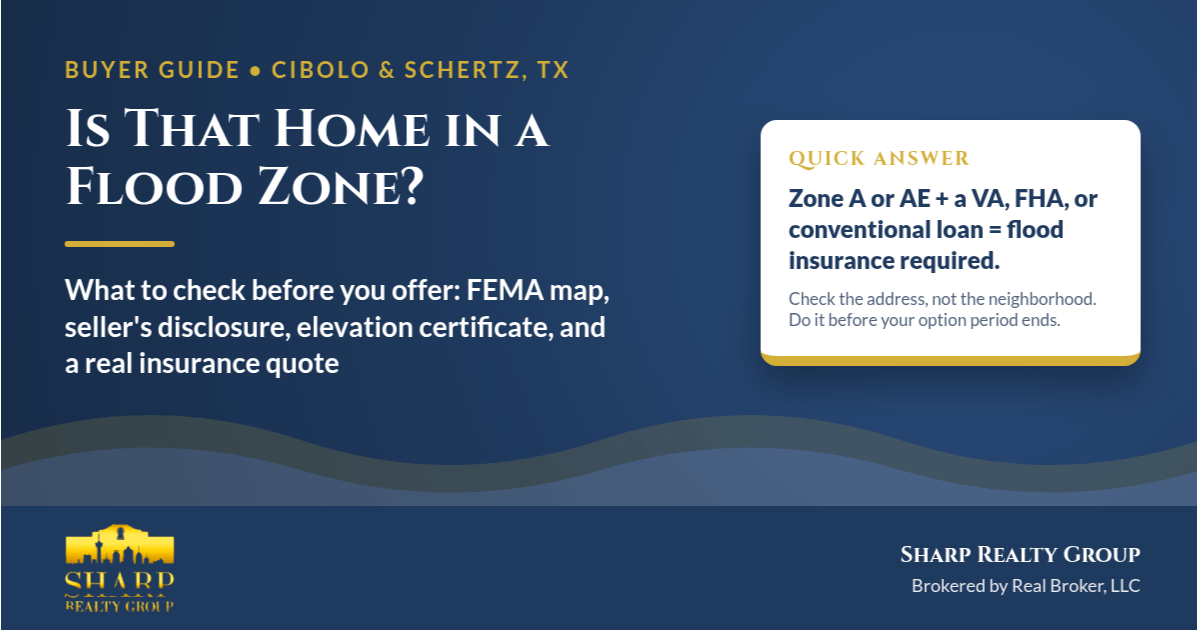
Look up the exact address on FEMA's Flood Map Service Center, then confirm it with the city (Schertz has an online flood hazard map; Cibolo's Planning Department can help). If any part of the home sits in a Special Flood Hazard Area (Zone A or AE), a VA, FHA, or conventional lender will require flood insurance. Before your option period ends, read the flood section of the Seller's Disclosure, ask for an elevation certificate and claims history, and get a written flood insurance quote so you know the real monthly payment.
By Anthony Sharp |
Quick reality check. On July 15–16, 2026, Cibolo Creek flooded overnight. Schertz signed a disaster declaration, called a mandatory evacuation for an RV park near the creek and voluntary evacuations along southern FM 78 and FM 1518, and closed more than a dozen roads and low-water crossings. City officials said the creek crested around 22.5 feet before it started dropping (KENS 5; KSAT).
And flood maps aren't set in stone. FEMA revises them through Letters of Map Revision (LOMRs), and a revision can move zone lines, base flood elevations, and the regulatory floodway. FEMA lists proposed changes by community on its BFE status page, so it's worth a look before you offer.
So if you're shopping in Cibolo or Schertz right now, "is it in a flood zone?" isn't a someday question. It belongs before you write the offer.
The advice on Reddit is the same every time someone asks: get flood insurance quotes before you make an offer, check the FEMA map, and ask the seller for the claim history. That's right. Here's how I do it for my buyers here, step by step.
What the flood zone letters mean for your loan
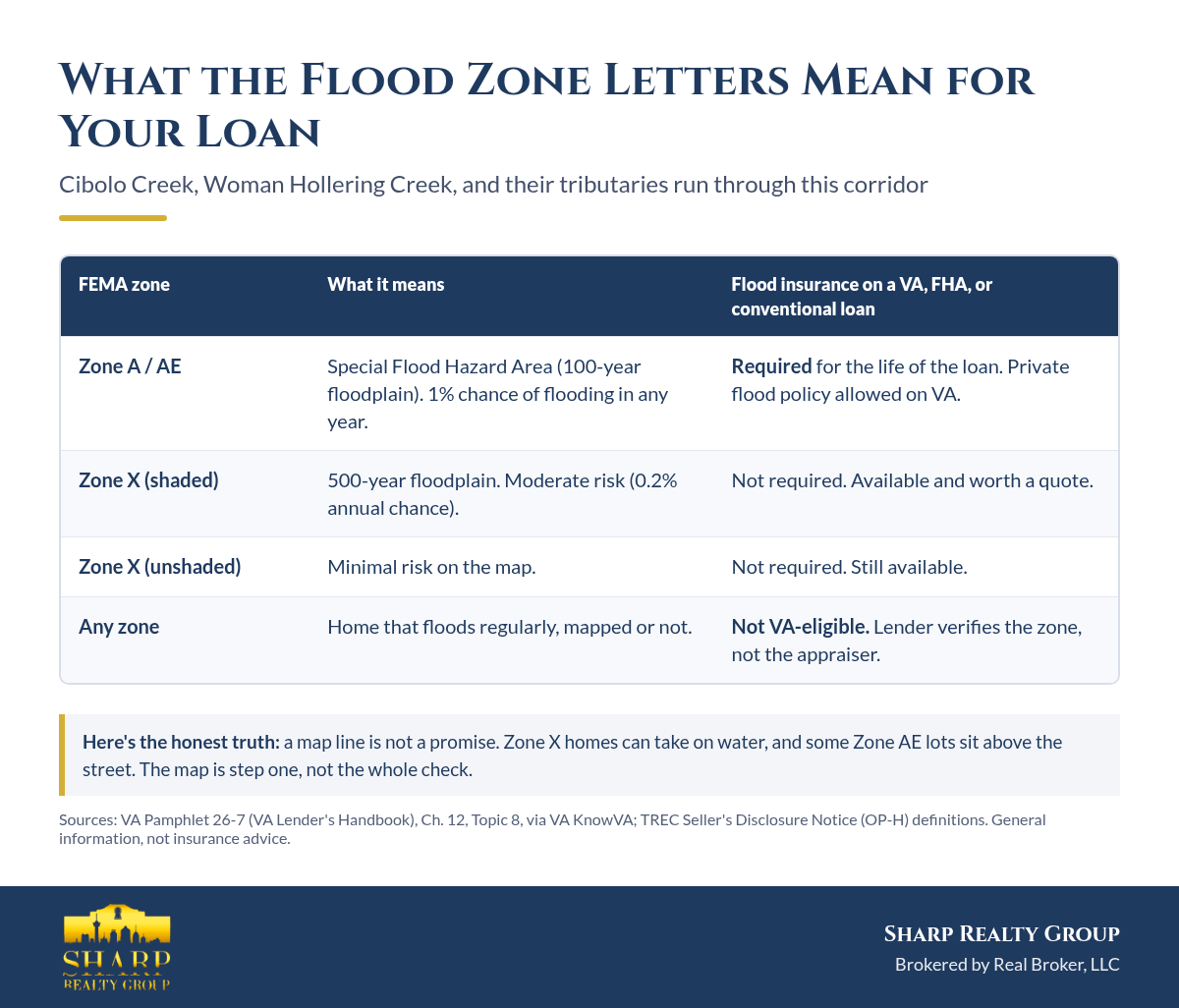
FEMA's maps sort land into zones. The zones you'll see most around Cibolo Creek, Woman Hollering Creek, and their tributaries:
- Zone A / AE (Special Flood Hazard Area). The "100-year floodplain" — a 1% chance of flooding in any year. If the home is in one and you're using a VA, FHA, or conventional loan, flood insurance is required for the life of the loan.
- Zone X (shaded). The "500-year floodplain" — moderate risk. Insurance isn't required by the lender.
- Zone X (unshaded). Minimal risk on the map. Not required, still available.
For VA buyers, here's the official wording from VA Pamphlet 26-7 (the VA Lender's Handbook), Chapter 12, Topic 8, "Special Flood Hazard Area" (VA KnowVA):
Flood Insurance. “Properties located in a FEMA Special Flood Hazard Area (SFHA) must be covered by a flood insurance policy. Properties located in a SFHA are not eligible if flood insurance is not available.”
Regular Flooding. “Based on the appraiser’s knowledge of the market area, properties that are subject to regular flooding are not eligible, whether or not the area has been designated an SFHA.”
Verification of Flood Zone. “While appraisers must provide flood zone information on the appraisal report, flood zone maps do not typically indicate the location of specific properties. Lenders are responsible for verifying the flood zone information.”
Excluding Non-Residential Improvements. “At the Veteran’s request, non-residential improvements such as detached garages and small sheds may be excluded from the flood insurance policy if they are also excluded from the appraised value. The cost of flood insurance with and without coverage for the detached building should be compared as excluding a detached building may not be worthwhile.”
Private Flood Insurance. “Veterans may elect to obtain private flood insurance instead of obtaining flood insurance through the National Flood Insurance Program.”
In plain English: in Zone A or AE, flood insurance is required, and private flood insurance counts. A home that floods regularly can be turned down even if it's off the map. Your lender, not the appraiser, verifies the zone. And if you want to leave a detached garage or shed off the policy, compare the cost both ways first.
Here's the honest truth: a map line is not a promise. Zone X homes can take on water, and plenty of Zone AE lots sit higher than the street. That's why the map is step one, not the whole check.
The 5-step flood check I run on every Cibolo and Schertz home
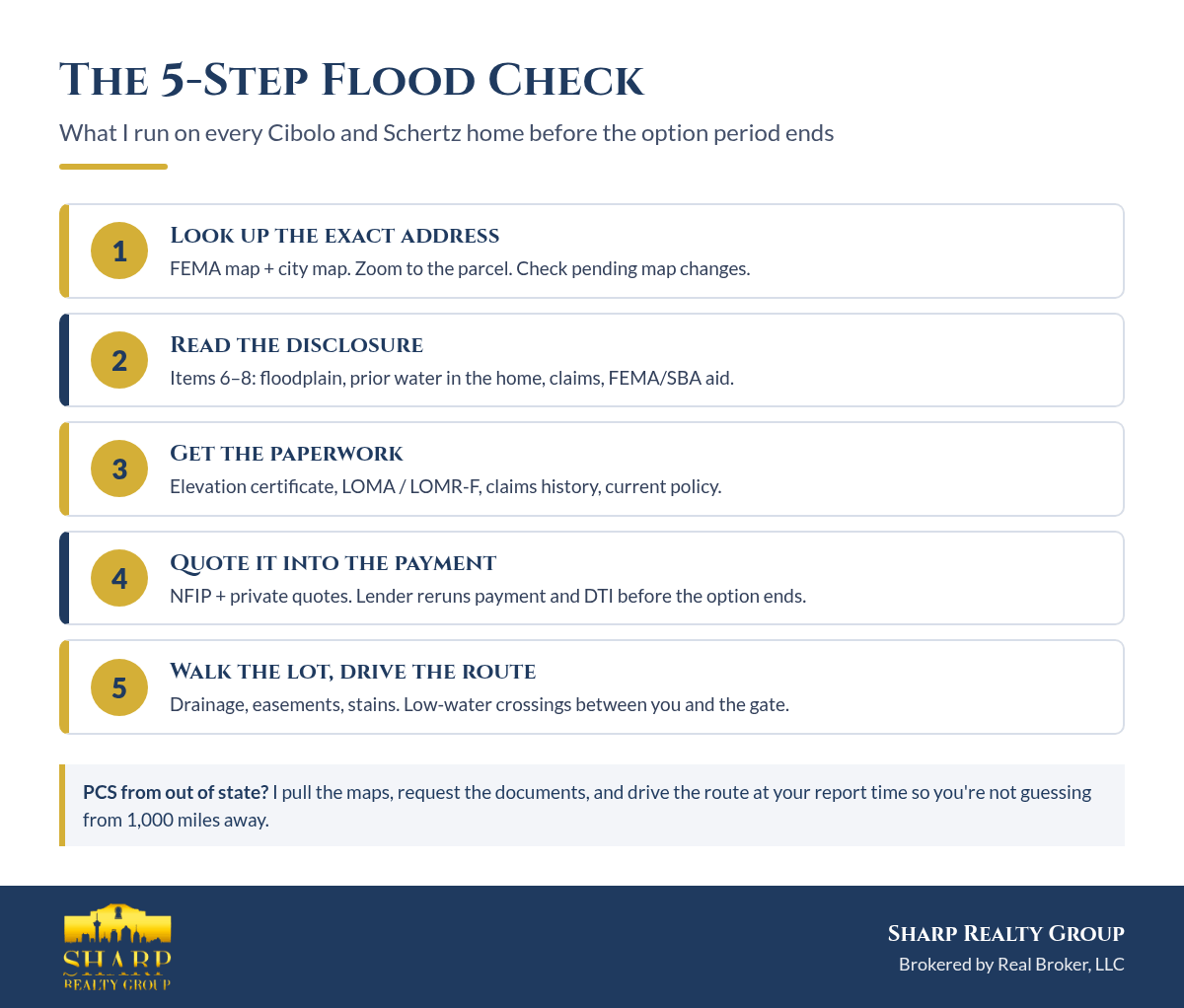
1. Look up the exact address (and any pending changes)
Go to FEMA's Flood Map Service Center and type the street address. Zoom to the parcel, not the neighborhood. Lot lines matter — homes on the same street can fall on different sides of a zone line.
Then check locally:
- Schertz: the city's Flood Plain Management page links its flood hazard map and floodplain administrator.
- Cibolo: the City of Cibolo Planning Department can help confirm a flood zone.
- Pending changes: FEMA lists proposed revisions on its BFE status page. Pick Cibolo or Schertz from the community list if the home is near a creek or drainage channel.
2. Read the flood questions on the Seller's Disclosure (items 6–8)
Texas sellers use TREC's Seller's Disclosure Notice (OP-H). Item 6 asks whether the seller knows of current flood insurance, previous water getting into the house from a natural flood or a reservoir release, and whether the home sits wholly or partly in a 100-year floodplain, 500-year floodplain, floodway, flood pool, or reservoir. Item 7 asks whether they've ever filed a flood claim. Item 8 asks whether they've received FEMA or SBA assistance for flood damage.
Any "yes" means I ask for the details in writing. If you're new to the form, here's my walkthrough on how to read the Texas Seller's Disclosure.
3. Ask for the paperwork that changes the price of insurance
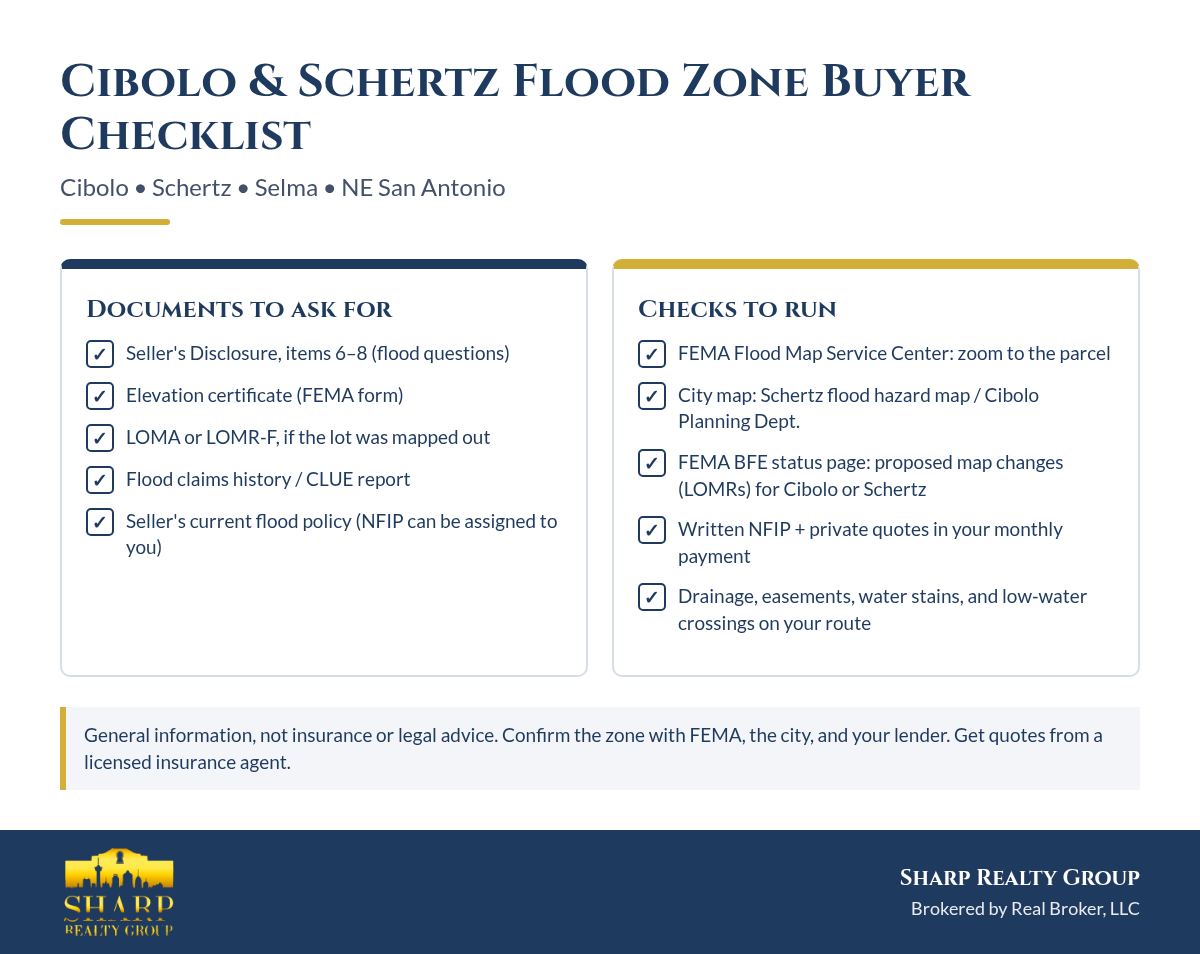
- Elevation certificate. FEMA's form showing the home's elevation compared with the base flood elevation. It can lower a quote — or raise one.
- LOMA or LOMR-F. A Letter of Map Amendment (or Revision based on Fill) is FEMA's official letter that a structure or lot is out of the SFHA. Many newer subdivisions near creeks have them.
- Claims history. Ask for the seller's flood claims and, if possible, a CLUE report of past insurance claims.
- The seller's current flood policy. An NFIP policy can be assigned to you at closing, and certain NFIP discounts carry over when it's assigned. Ask your insurance agent whether taking it over beats a new policy.
4. Get a written quote and put it in the payment
This is the step people skip, and it's the one that bites.
Get at least one NFIP quote and one private quote using the address and elevation certificate. Then have your lender add the premium to your monthly payment and debt-to-income math before your option period ends.
Why that matters for PCS buyers: your BAH doesn't care which zone you're in, but your monthly payment does.
Good news on timing: when you buy NFIP coverage in connection with your loan closing, it can take effect at closing instead of waiting the normal 30 days, as long as the application and premium are in by closing.
5. Walk the lot and drive the route
Map or no map, look at the ground:
- Which way does the yard drain? Toward the house or away?
- Is there a drainage easement, channel, or detention pond behind the fence?
- Water stains on garage walls, fresh baseboards, or new drywall low on the walls — ask why.
- Your general home inspector will report visible drainage and grading issues. Read that section closely.
Then drive your route to the gate. During the July flood, Schertz closed spots like FM 1518 at Maske Road, Schaefer Road, Weir Road at Cibolo Creek, and several low-water crossings. If your daily drive to Randolph crosses a low-water crossing, you want to know that before you commit — not the first time it rains hard.
Where this fits in your contract
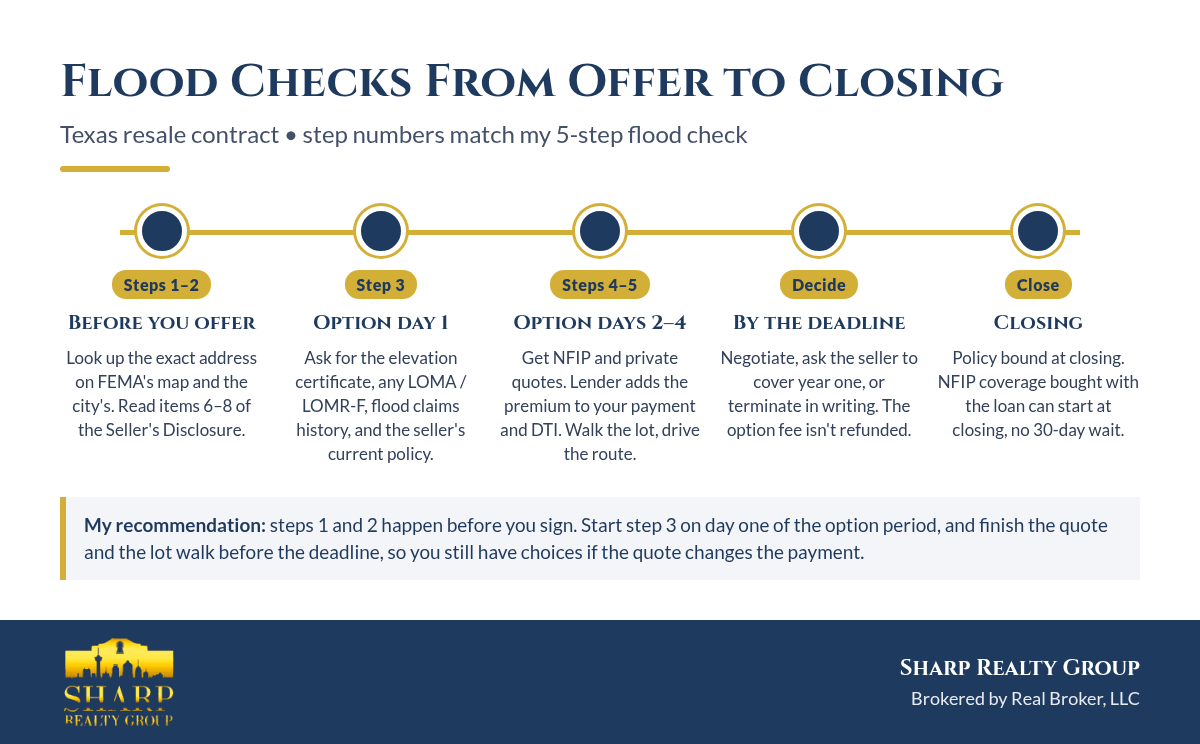
In Texas, the option period is your clean window. You can terminate for any reason by the deadline, which makes it the right time for flood homework. The fee isn't refunded, but your earnest money is protected if you terminate in writing on time.
My recommendation: do steps 1 and 2 before you write the offer. Start step 3 on day one of the option period, and finish the quote and the lot walk before the deadline. If the quote or the paperwork doesn't sit right, you've still got time to negotiate, ask the seller to cover the first year, or walk.
Buying from out of state on PCS orders? This is exactly the kind of legwork I handle when you can't be here. I pull the maps, request the documents, drive the route at your report time, and send you a short video of the lot after a rain if the timing works.
Buying new construction? Ask the builder's sales office for the lot's flood zone, the elevation certificate, and any LOMR-F before you pick a lot near a creek or drainage channel. Lot premiums and incentives don't mean much if the insurance changes the payment.
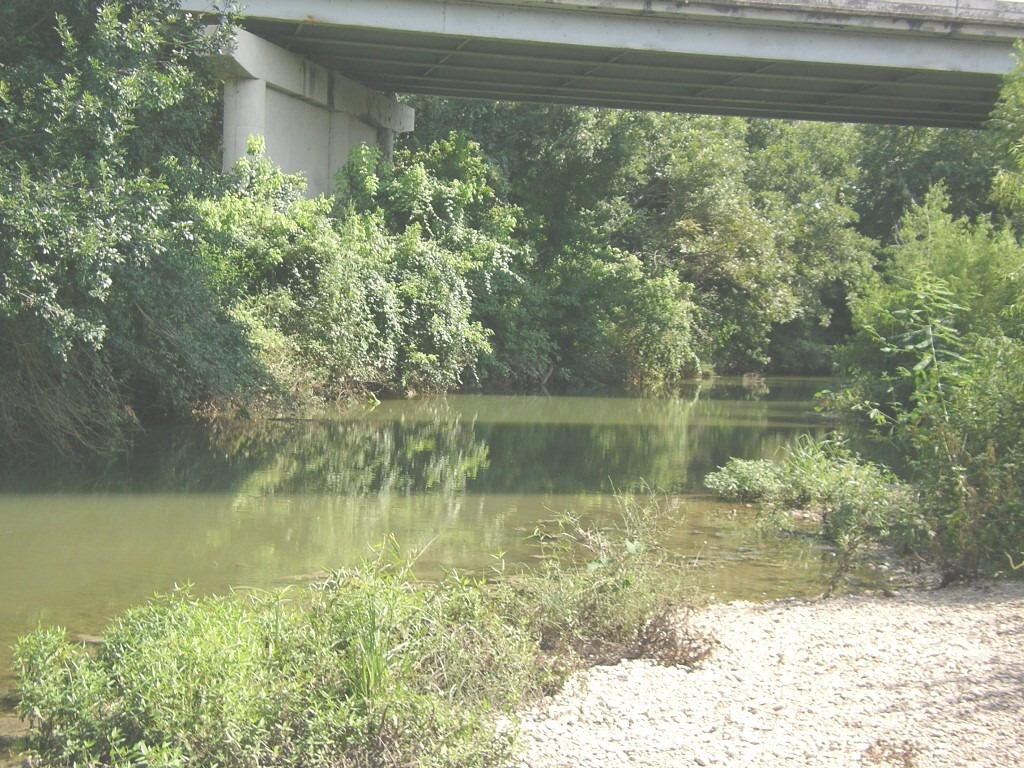 Cibolo Creek at Interstate 10 near Schertz, TX. Photo: KenB, CC BY-SA 3.0, via Wikimedia Commons.
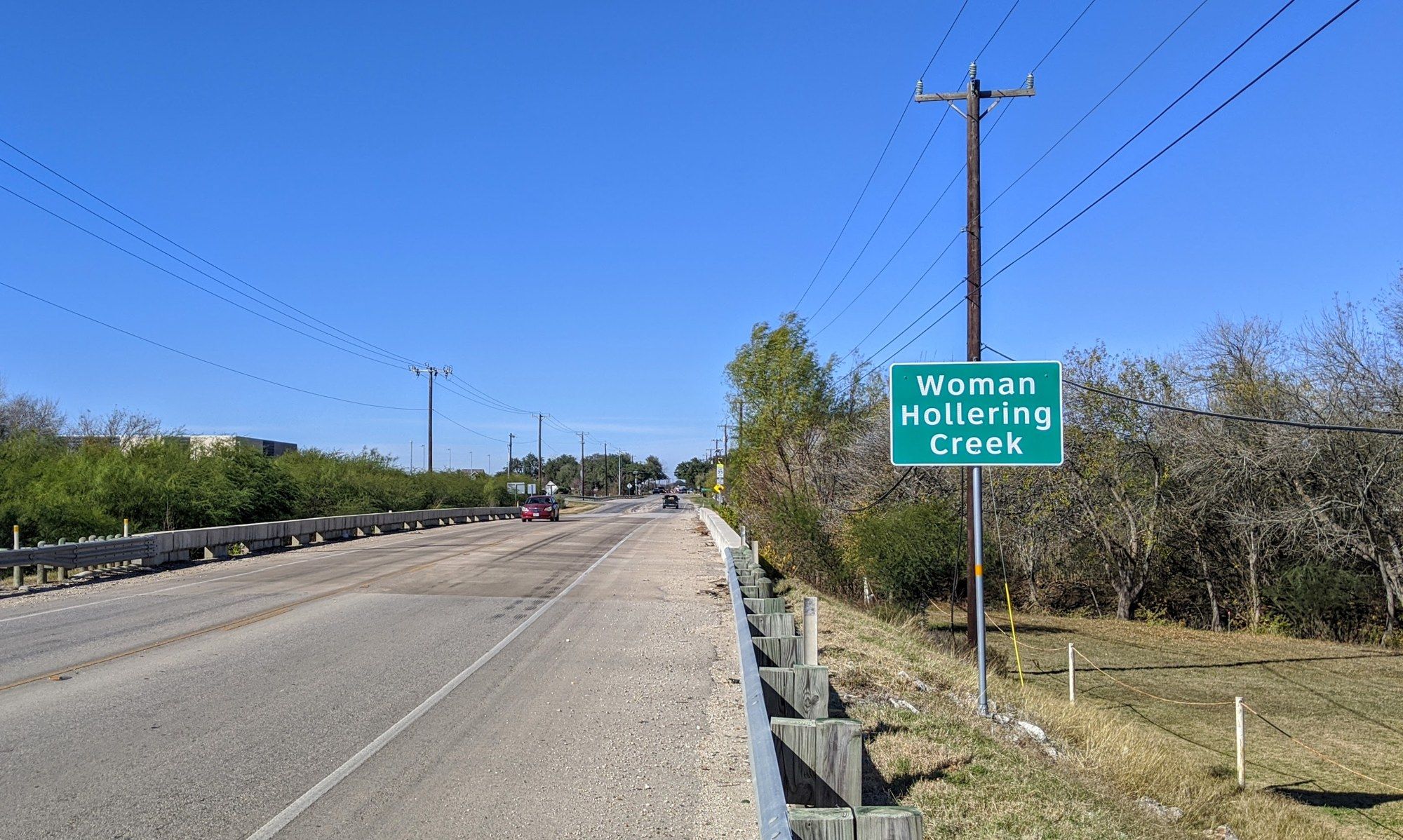 Woman Hollering Creek on FM 1518, Schertz, TX. Photo: Dicklyon, CC BY-SA 4.0, via Wikimedia Commons.
Frequently Asked Questions
Do I need flood insurance on a VA loan in Cibolo or Schertz?
Only if the home is in a FEMA Special Flood Hazard Area (Zone A or AE). Then it's required for the life of the loan, and private flood insurance is allowed. In Zone X it's optional, but the VA also won't approve a home that floods regularly even if it's not mapped.
How do I check the flood zone for a specific address?
Search the address on FEMA's Flood Map Service Center and zoom to the parcel. Then confirm with the city — Schertz has an online flood hazard map, and Cibolo's Planning Department can help. Your lender will also order an official flood zone determination.
Does a Texas seller have to tell me if the house flooded?
Yes, to the best of their knowledge. The TREC Seller's Disclosure Notice asks about prior flood water in the home, floodplain location, current flood insurance, past flood claims, and FEMA or SBA flood assistance. Ask for written details on any "yes."
Can I back out if I find out the house is in a flood zone?
If you're still in your option period, yes. You can terminate in writing by the deadline for any reason and keep your earnest money, though the option fee isn't refunded. That's why I put the flood check at the very start of the option period.
Will a FEMA flood map change affect the home I'm buying?
It depends on the address. A Letter of Map Revision can move zone lines and base flood elevations. Check FEMA's BFE status page for any proposed changes in Cibolo or Schertz, and if one is pending near the home, ask your insurance agent to quote under both the current and proposed maps.
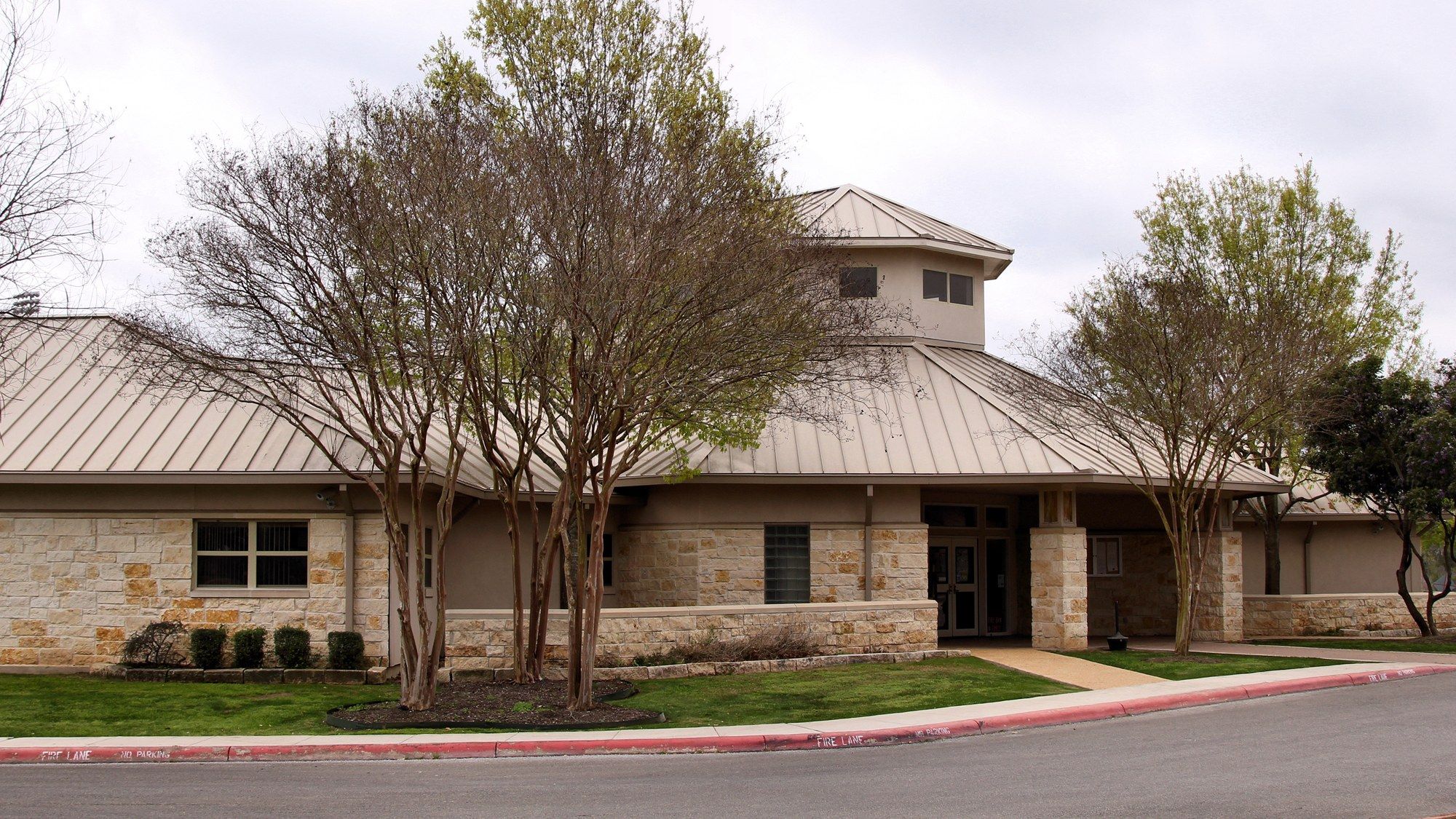 Cibolo City Hall, Cibolo, TX. Photo: Larry D. Moore, CC BY 4.0, via Wikimedia Commons.
Your next move
Flood zones in Cibolo and Schertz come down to one address at a time. Check the map, read the disclosure, get the quote into your payment, and do it while your option period still gives you choices.
If you've got a specific home in mind, book a quick call on my calendar and send me the address. I'll pull the flood map, the disclosure, and the questions to ask before you offer. Still a few months out? Grab my free PCS to JBSA guide — it walks through the whole move, from orders to keys.
Talk soon, Anthony
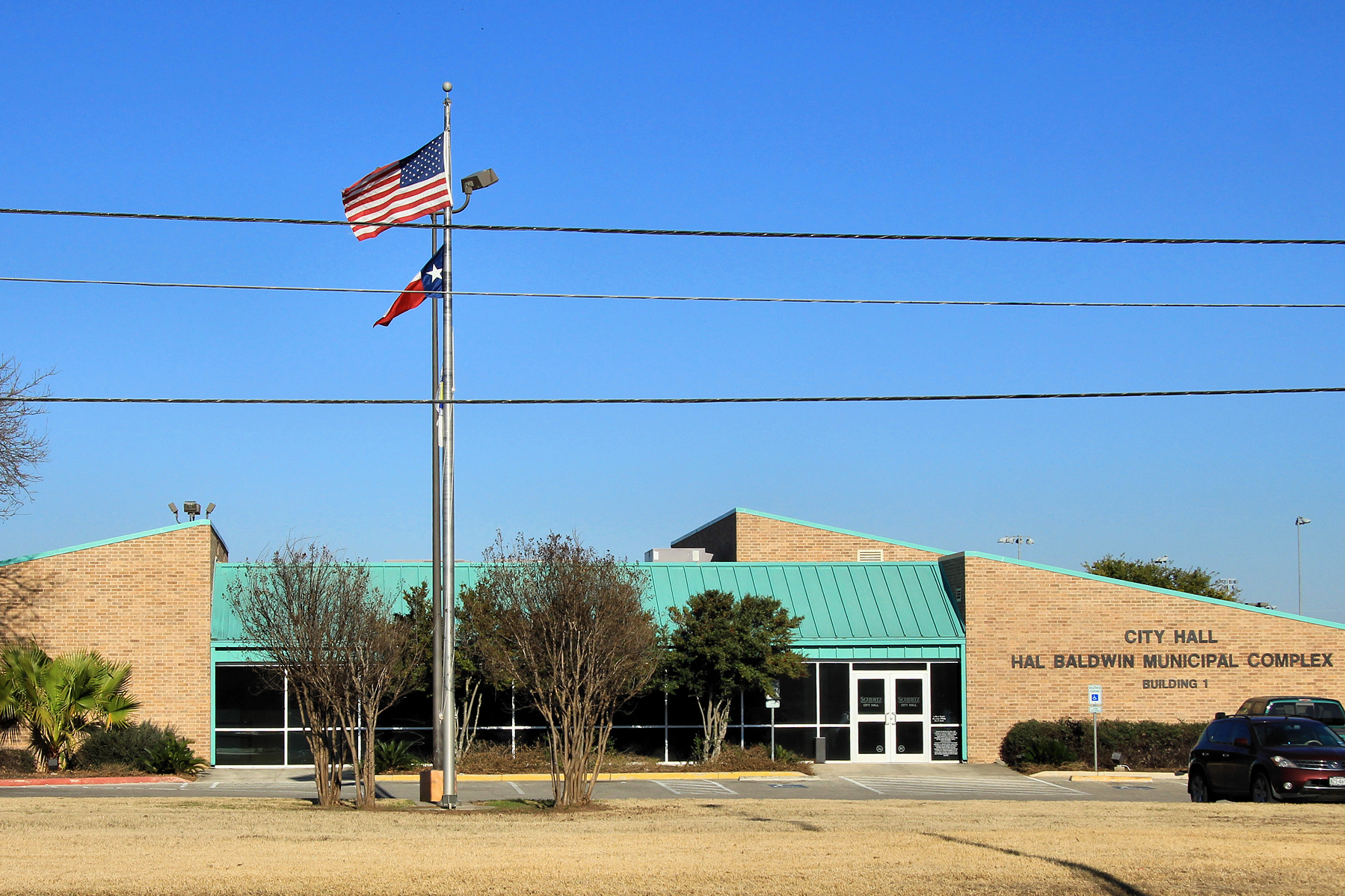 Schertz City Hall, Schertz, TX. Photo: Larry D. Moore, CC BY 4.0, via Wikimedia Commons.
About Anthony Sharp: I'm a Realtor with Sharp Realty Group, brokered by Real Broker, LLC. I live in Cibolo and help buyers and sellers across Cibolo, Schertz, Selma, and Northeast San Antonio, including VA and new-construction buyers. I served 9 years active duty in the U.S. Air Force and hold NAR's Military Relocation Professional (MRP) certification.
This post is general information, not insurance, legal, or financial advice. Flood risk and insurance requirements are property-specific. Confirm a home's flood zone with FEMA, the city, and your lender, and get written quotes from a licensed insurance agent. Sources: VA Pamphlet 26-7 (VA Lender's Handbook), Chapter 12, Topic 8, via VA's KnowVA knowledge base, Article ID 554400000314692 (KnowVA); TREC Seller's Disclosure Notice (OP-H), items 6–8, and Texas Property Code §5.008; FEMA NFIP Flood Insurance Manual; FEMA Flood Hazard Determinations (BFE status) page; City of Schertz, KENS 5, and KSAT reports on the July 2026 Cibolo Creek flood.
Related reading: Buyer Closing Costs in San Antonio (2026) · PCS to JBSA: Buying a Home Before You Arrive · Do You Need a Structural Engineer for a Cibolo Foundation Check?
Categories
- All Blogs (306)
- BAH (4)
- Buying Process (2)
- Cibolo (3)
- For Home Buyers (209)
- For Home Sellers (96)
- For Investors (45)
- For Military Service Members (201)
- For Renters (10)
- Home Inspections (1)
- JBSA (9)
- Local Events (12)
- Local Real Estate News (41)
- Market Updates (44)
- Military Relocation (46)
- Neighborhood Tours (58)
- PCS Move (120)
- Property Tours (7)
- Schertz (3)
- VA Loans (22)
Recent Posts