
Low VA Appraisal in Cibolo or Schertz? Your 4 Options
VA Appraisal Came in Low on a Cibolo or Schertz Home? Your 4 Options
What do I do if my VA appraisal comes in low on a Cibolo or Schertz home?
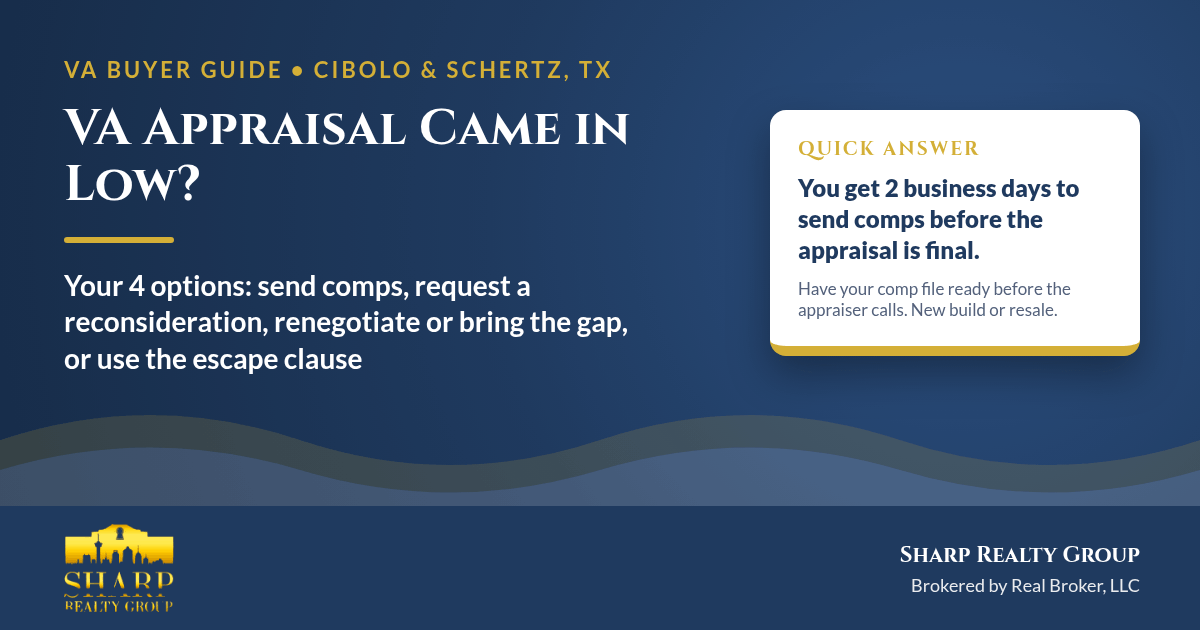
You have four moves, and you can work more than one at once. Before the appraisal is final, send closed comparable sales during the Tidewater window (the appraiser gives you 2 business days). After the Notice of Value (NOV), request a reconsideration of value in writing through your lender. You can also renegotiate the price or bring the gap in cash. If nothing works, the VA escape clause lets you cancel without losing your earnest money. A low appraisal is a negotiation, not an automatic dead deal.
By Anthony Sharp |
Quick reality check. A VA appraisal that lands under the contract price is one of the most common panic posts from VA buyers online. It keeps coming up on r/RealEstate, r/VeteransBenefits, r/VAConstructionloans, and r/vamortgages. One buyer needed $615K and got $595K. Another had a new build under contract and got word the appraiser was "calling Tidewater."
If you're buying in Cibolo, Schertz, or Selma with a VA loan, you can run into this on a new build or a resale. Here's the honest truth: it's fixable more often than people think, but only if you know the clock and the options before it happens.
Why the VA won't just finance the gap
The VA guarantees your loan based on the home's "reasonable value," not your contract price. The VA's own escape-clause page says that if you proceed anyway, "the loan amount would be capped at the lesser of the agreed-upon purchase price or the reasonable value (whichever is lower)."
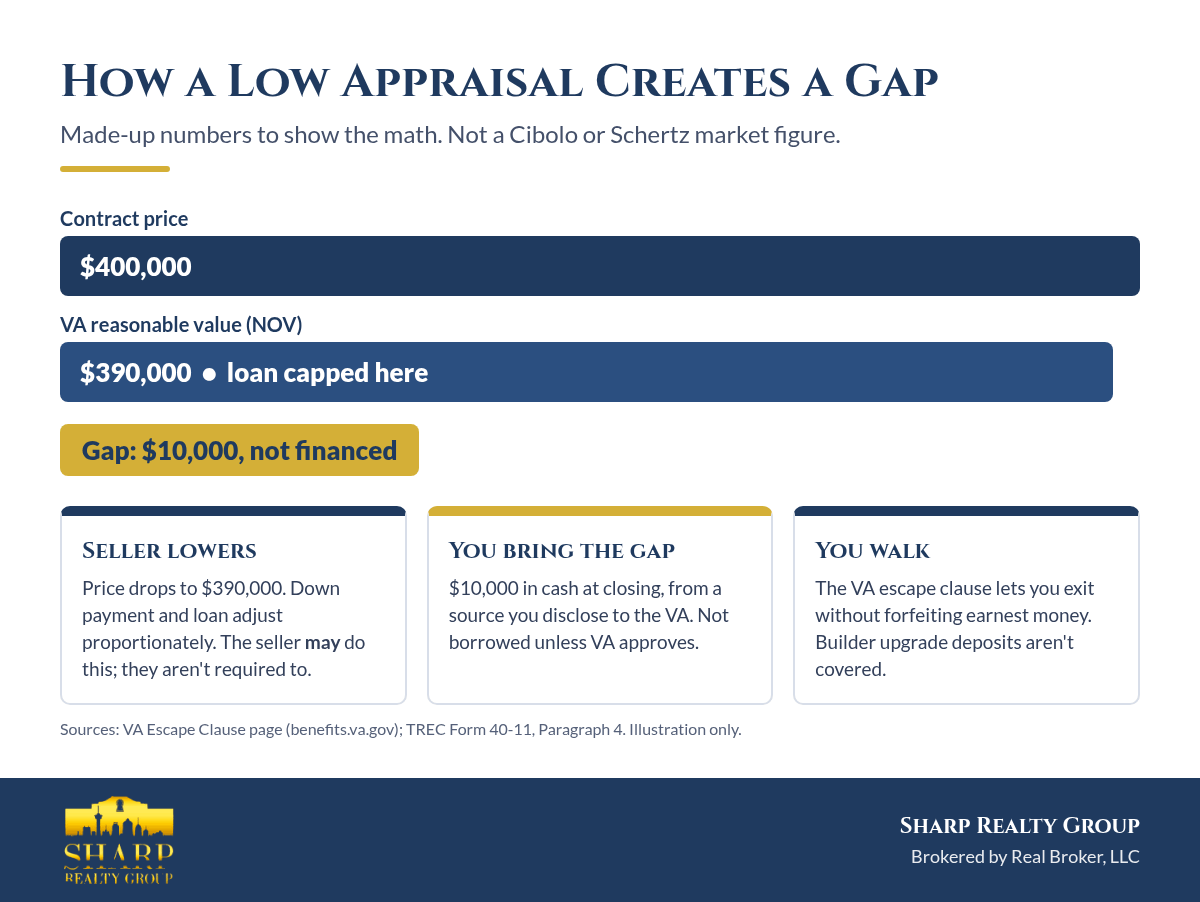
Here's a made-up example, just to show the math (not a Cibolo or Schertz market number):
- Contract price: $400,000
- VA reasonable value on the NOV: $390,000
- Gap: $10,000, and that part isn't financed.
A closing-cost credit doesn't change the contract price, so don't assume it closes a value gap. Ask your lender how a specific credit would be treated before you count on it.
Your 4 options, in the order I'd work them
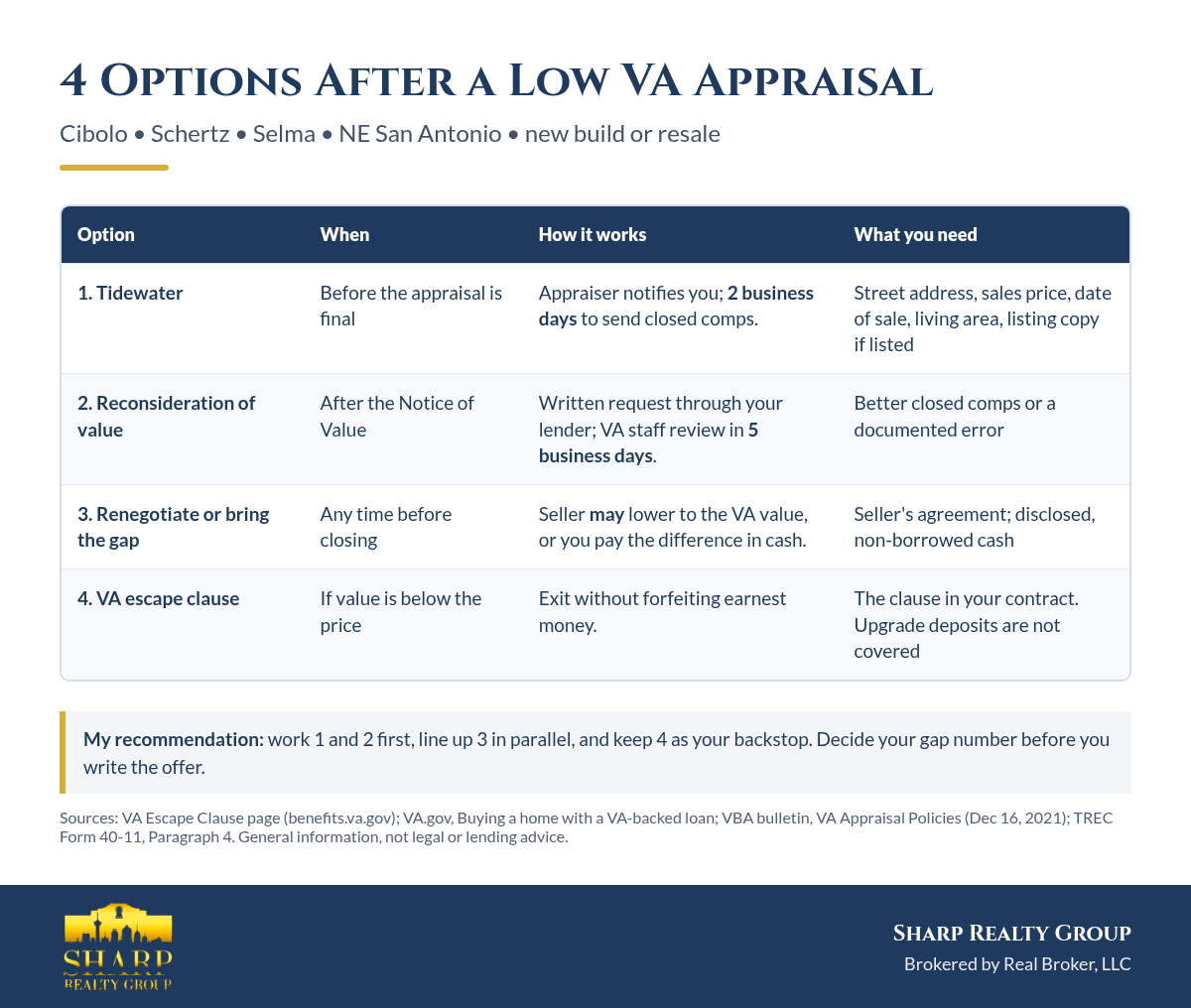
1. Tidewater: send comps before the appraisal is final
The VA calls this the Tidewater Procedure. In a December 2021 bulletin, the VA's Loan Guaranty Service describes it this way: "Before an appraisal is completed for a purchase transaction, the appraiser will notify the requester if it appears that the estimated market value will be below the sales price. The appraiser will allow 2 business days for the requester, or parties to the transaction contacted by the requester, to submit any additional sales data that they wish to have considered."
Two business days is not much. The VA Lender's Handbook (Chapter 10, Topic 8) says to send, for each comparable, the street address, sales price, date of sale, living area, and a copy of the listing if the home was listed.
My recommendation: have your comp file started before the appraiser ever calls. On a new build in Cibolo or Schertz, that means closed sales of the same builder and similar floor plan nearby, and any price changes the builder made after your contract date. Ask your lender to list your agent as the appraisal point of contact so the call goes to someone who can pull comps the same day.
2. Reconsideration of value (ROV): after the NOV
If the NOV still comes in low, the VA says you can "request a Reconsideration of Value (ROV)," and that "you can ask your real estate agent to provide the lender with valid sales data showing the property is worth more than its appraised price" (VA.gov). Per the VA's bulletin, staff review the report and your data within 5 business days. In some cases VA staff may do a field review, which the Handbook (Chapter 10, Topic 22) puts at up to 20 business days.
Treat it like a one-shot submission. Better closed comps or a documented error (square footage, a missed feature) beat "I disagree." Gather everything first, then submit once, through your lender, in writing.
3. Renegotiate or bring the gap
The VA lists two more moves: "Renegotiate the sales price. Ask the seller to lower the price to match the appraised value," or "Pay the difference between the appraised price and the sales price."
On a Texas resale, the TREC Third Party Financing Addendum (Form 40-11) covers the mechanics. If the VA reasonable value is less than the sales price, the "Seller may reduce the Sales Price to an amount equal to the VA reasonable value and the sale will be closed at the lower Sales Price with proportionate adjustments to the down payment and the loan amount." Notice the word may. The seller isn't forced to.
If you pay the gap yourself, the same form says you must pay it "in cash from a source which Buyer agrees to disclose to the VA and which Buyer represents will not be from borrowed funds except as approved by VA."
A builder can also say no to a price cut. That's their call. Then you're deciding between cash, a middle number, or option 4.
4. The VA escape clause: walk without losing earnest money
The VA says the escape clause "must always be included in a VA home loan purchase contract," and that it lets you "negotiate, proceed as is, or exit." It applies to new construction too. If it's missing, "the contract must be amended to include the clause before the loan closing."
On a Texas resale, that protection is in TREC Form 40-11, Paragraph 4, which adds: "The 3-day notice of termination requirement in Paragraph 2B does not apply to this Paragraph 4." The TREC new-home forms — Form 23-20, New Home Contract (Incomplete Construction), and Form 24-20, New Home Contract (Completed Construction), both dated 05-04-2026 — do not have the VA escape clause in the body. It comes in by attaching Form 40-11. Most builders use their own contracts, not the TREC new-home forms. VA still requires the clause either way.
Two limits to know:
- It only covers a low reasonable value. The VA says it "may not be used to cancel a loan purchase contract for any reason other than" that.
- Upgrade deposits are different. The VA says "deposits to the builder for upgrades for new construction are not considered earnest money and are not covered by the VA Escape Clause. The builder is not required to refund them."
That second one is the new-build trap. Before you pay design-center deposits, ask what happens to them if the appraisal fails. For more on how builder deals and incentives are structured around here, see my guide to builder incentives in Cibolo and Schertz. For the general version of this problem on any loan, see when your home appraisal comes in low in San Antonio.
The timeline, with your PCS date in mind
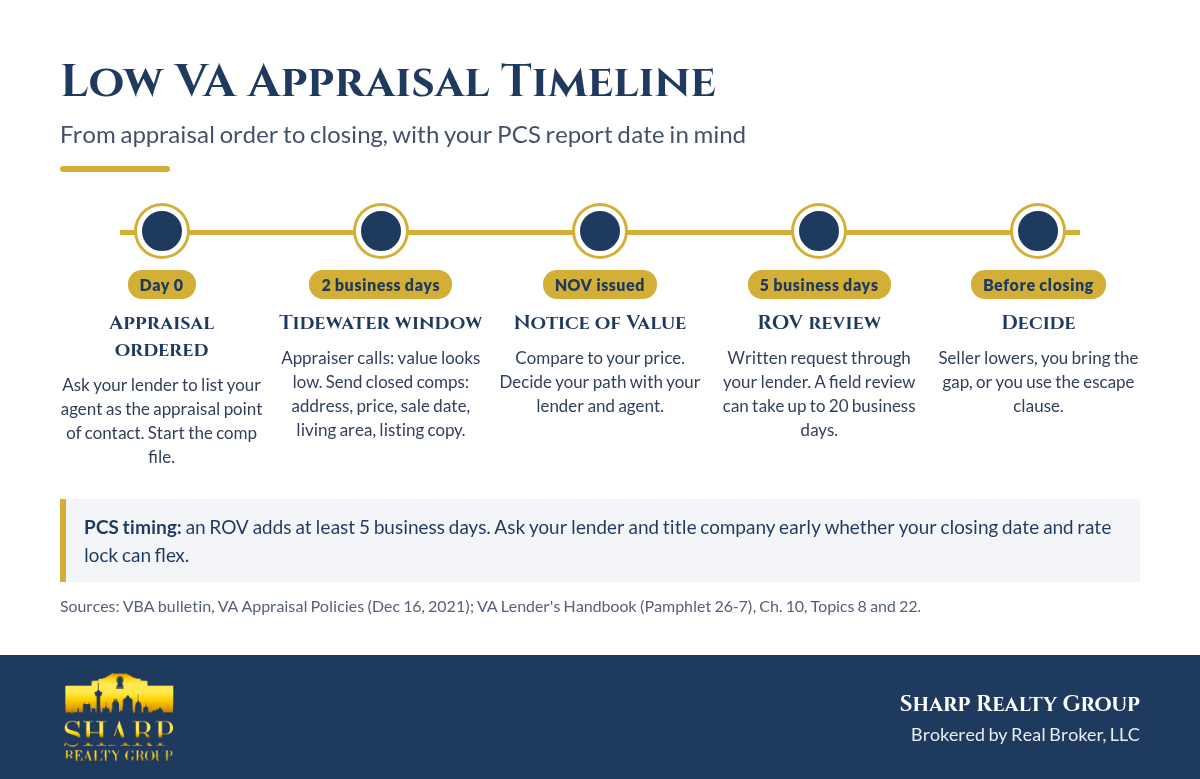
Your report date drives everything. An ROV adds at least 5 business days, and a field review adds more, so tell your lender and the title company early. Ask now whether your closing date, your rate lock, and your movers can flex a few days. I've helped over 100 military families buy or sell. My advice: decide your gap number before you write the offer, meaning the most cash, if any, you'd bring.
If you're the seller
If a VA buyer's appraisal comes in low on your Cibolo or Schertz home, you have three choices: lower the price to the VA value, meet in the middle (when the buyer brings some cash), or hold your price and risk the buyer using the escape clause. Re-listing means new showings and a new appraisal from a different buyer. Compare the cost of a price cut to the cost of starting over.
Your agent should be pulling closed comps for the appraiser in the Tidewater window, not after the NOV. That is where a value gets saved most often.
Before you write the offer
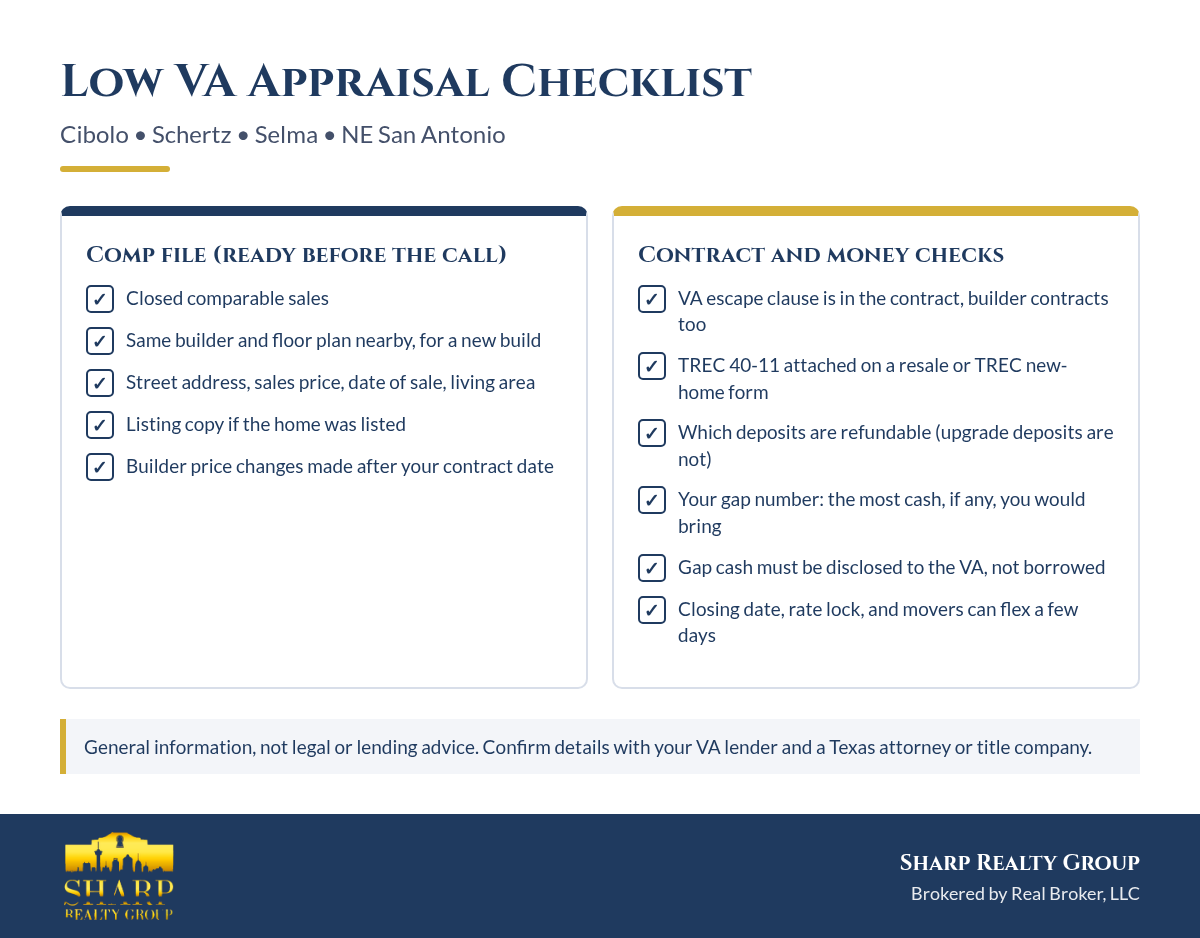
- Pre-approval done and COE in hand, so the appraisal is the only open variable.
- The VA escape clause is in the contract, including builder contracts. On a TREC new-home form (23-20 or 24-20), that means Form 40-11 is attached; most builders use their own contracts, and VA still requires the clause.
- You know your gap number.
- You know which deposits are refundable and which aren't.
- Value and condition are separate questions. For the condition side, see my post on whether you need a structural engineer for a Cibolo foundation check.

Entrance to Niemietz Park, Cibolo, TX. Photo: Larry D. Moore, CC BY 4.0, via Wikimedia Commons.
Frequently Asked Questions
Does a low VA appraisal kill my deal in Cibolo or Schertz?
Not by itself. The VA lists renegotiating, paying the difference, or requesting a reconsideration of value as options. If none of those work, the escape clause lets you exit without losing earnest money.

Cibolo city limits sign, Cibolo, TX. Photo: Jonmallard, CC BY-SA 4.0, via Wikimedia Commons.
How long do I have to send comps when the appraiser calls with a Tidewater notice?
The VA says the appraiser will allow 2 business days. After that the appraiser completes the report, so have closed comps ready before the call.
Does the seller have to lower the price to the VA value?
No. On the TREC 40-11 form, the seller "may" reduce the price to the VA reasonable value. If the seller won't, you can bring the gap in cash, find a middle number, or use the escape clause.
Do I get my builder upgrade deposit back if I cancel?
Not necessarily. The VA says upgrade deposits are not earnest money, are not covered by the escape clause, and the builder is not required to refund them. Check your builder contract before you pay them.
Can I use a loan or borrowed money to cover the gap?
TREC 40-11 says the cash must come from a source you disclose to the VA that "will not be from borrowed funds except as approved by VA." Ask your lender before you move any money.

VFW post on FM 78, Schertz, TX. Photo: Jonmallard, CC BY-SA 4.0, via Wikimedia Commons.
Your next move
A low VA appraisal is a clock, not a verdict. Know the 2-business-day Tidewater window, have your comps ready, and know your gap number before you offer.
If you have a home in mind, book a quick call on my calendar and send me the address. I'll look at the recent closed sales and the contract language before you offer. Still a few months out from orders? Grab my free PCS to JBSA guide for the whole move, from orders to keys.
Talk soon,
Anthony

Selma Municipal Complex, Selma, TX. Photo: Larry D. Moore, CC BY 4.0, via Wikimedia Commons.
About Anthony Sharp: I'm a Realtor with Sharp Realty Group, brokered by Real Broker, LLC. I live in Cibolo and help buyers and sellers across Cibolo, Schertz, Selma, and Northeast San Antonio, including VA and new-construction buyers. I served 9 years active duty in the U.S. Air Force and hold NAR's Military Relocation Professional (MRP) certification.
This post is general information, not legal, lending, or financial advice. VA and lender rules change and vary by loan, so confirm the details with your VA lender and a Texas attorney or title company. Sources: U.S. Department of Veterans Affairs, "VA Escape Clause" (https://www.benefits.va.gov/homeloans/escape-clause.asp); VA.gov, "Buying a home with a VA-backed loan" (https://www.va.gov/housing-assistance/home-loans/home-buying-process/, updated Jan 7, 2026); VBA Loan Guaranty Service bulletin, "VA Appraisal Policies," Dec 16, 2021 (https://content.govdelivery.com/accounts/USVAVBA/bulletins/300ac69); VA Circular 26-22-15 (https://www.benefits.va.gov/HOMELOANS/documents/circulars/26_22_15.pdf); VA Pamphlet 26-7 (VA Lender's Handbook), Chapter 10, Topics 8 and 22; TREC Third Party Financing Addendum, Form 40-11 (https://www.trec.texas.gov/sites/default/files/pdf-forms/40-11.pdf).
Related reading: Builder Incentives in Cibolo & Schertz · When Your Home Appraisal Comes In Low: San Antonio 2026 · Do You Need a Structural Engineer for a Cibolo Foundation Check?
Categories
- All Blogs (307)
- BAH (4)
- Buying Process (3)
- Cibolo (4)
- For Home Buyers (209)
- For Home Sellers (96)
- For Investors (45)
- For Military Service Members (201)
- For Renters (10)
- Home Inspections (1)
- JBSA (9)
- Local Events (12)
- Local Real Estate News (41)
- Market Updates (44)
- Military Relocation (46)
- Neighborhood Tours (58)
- PCS Move (121)
- Property Tours (7)
- Schertz (4)
- VA Loans (23)
Recent Posts