The Ultimate VA Loan Guide: Everything You Need to Know from an Air Force Veteran
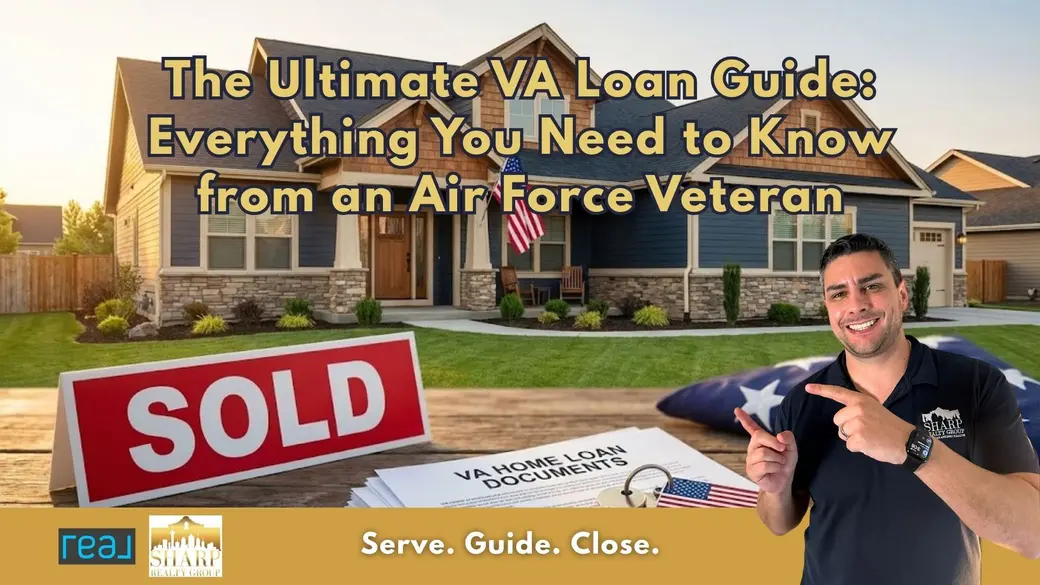
I still remember sitting in a lender's office during my first home purchase, completely overwhelmed by mortgage jargon. As an Air Force officer, I'd led teams through complex missions, but navigating the VA loan process felt like learning a foreign language. That experience shaped how I serve military families today as a San Antonio Realtor, by cutting through the confusion and giving you straight answers about one of your most valuable military benefits.
This ultimate VA loan guide covers everything from basic eligibility to loan assumptions, credit requirements, and the real-world questions I hear from service members preparing for their next PCS move to San Antonio.
Ready to use your VA benefit? Let's discuss your home buying goals with someone who's been in your boots. Visit https://sharprealtygrouptx.com/consult
Why VA Loans Outperform Every Other Mortgage Option
The VA home loan program stands as the most powerful benefit earned through military service. While conventional mortgages demand 20% down payments to avoid private mortgage insurance, VA loans require zero down payment and eliminate PMI entirely.
This combination means a service member can purchase a home without draining their savings account or postponing homeownership for years. The numbers tell the story clearly.
In 2025, VA loan limits increased to $806,500 for most counties, with high-cost areas reaching $1,089,300 for single-family homes. Throughout San Antonio, near Randolph AFB, Fort Sam Houston, and Lackland AFB, these limits provide substantial purchasing power for military families.
The competitive interest rates consistently beat conventional options, even for borrowers rebuilding their credit. Beyond the financial advantages, VA loans offer flexibility that matters to military life. You can use the benefit multiple times throughout your career, refinance with streamlined processes, and even allow qualified buyers to assume your loan when PCS orders arrive.
The Truth About VA Loan Credit Requirements
One question dominates every initial conversation I have with military buyers: "What credit score do I need?" The answer surprises most people.
The VA itself doesn't mandate a minimum credit score, individual lenders set their own standards. Most require at least 620, though some approve borrowers as low as 550.
I've worked with service members who ask whether they can use their VA loan with a 500 credit score. Technically, the VA doesn't prohibit it, but finding a willing lender proves extremely difficult. Most servicers want to see 580 or higher, and scores below 620 trigger higher interest rates and stricter income verification.
My advice? Work to raise your score above 620 before applying, it opens significantly more doors and better terms.
The VA evaluates your complete financial picture beyond just the credit score. Lenders examine debt-to-income ratios, residual income (the money left after paying all debts and expenses), employment stability, and payment history. Military families with past financial challenges shouldn't assume they're disqualified.
Understanding residual income makes a real difference in the approval process. If your debt-to-income ratio exceeds 41%, your residual income must exceed the regional requirement by at least 20%. For a family of four in Texas, that means meeting specific monthly leftover income thresholds that ensure you can comfortably afford the mortgage payment.
Making Sense of VA Loan Fees and Rules
Two specific rules create confusion among first-time VA buyers, and I want to clarify them immediately.
The 1% rule caps lender origination fees at one percent of the loan amount. On a $300,000 VA loan, the lender cannot charge more than $3,000 as their flat fee. This protection ensures veterans avoid excessive charges and keeps the loan affordable.
The 4% rule limits seller concessions to four percent of the home's reasonable value as determined by the VA appraisal. Seller concessions cover non-standard items like paying your funding fee, prepaid escrows, debt payoffs, or interest rate buydowns.
Standard closing costs fall outside this cap and can be paid entirely by the seller. During negotiations, especially in competitive markets, understanding this distinction can make the difference between winning and losing a bidding war.
The VA funding fee, the most misunderstood cost in the program, ranges from 1.25% to 3.3% depending on down payment size and whether you're a first-time or subsequent user. Veterans with service-connected disabilities and Purple Heart recipients qualify for complete exemption from this fee. Most borrowers roll the funding fee into the loan amount rather than paying it upfront at closing.
VA Loan Assumptions: The Game-Changer in Today's Market
Navigating VA loan rules during your San Antonio home search? I'll handle the details so you can focus on finding the right home. Visit sharprealtygrouptx.com
The assumption market has exploded across San Antonio as buyers chase lower interest rates locked in before 2023. When you assume a VA loan, you take over the seller's existing mortgage, preserving their interest rate, loan balance, and remaining term.
With rates from 2020-2022 sitting around 2.5% to 3.5% and current rates hovering near 6.5% to 7%, the savings can reach hundreds of dollars monthly. Every VA loan is assumable, whether in Texas or any other state, as long as the loan remains current and the servicer approves the qualified buyer.
Who Can Assume a VA Loan in Texas
Both veterans and civilians can assume VA loans, though the implications differ significantly based on who's buying. Veterans can substitute their own entitlement into the assumed loan, which restores the seller's entitlement immediately. This substitution allows that military seller to use their VA benefit again without waiting for the assumed loan to be paid off.
Civilian buyers present a different scenario. They're legally allowed to assume VA loans if they meet credit and income requirements, but they cannot restore the seller's entitlement.
The seller's entitlement remains tied to that loan until it's completely paid off or refinanced. If the civilian buyer later defaults or experiences foreclosure, the original veteran borrower loses that portion of their entitlement entirely.
How Much Does VA Loan Assumption Cost
The cost to assume a VA loan runs significantly lower than originating a new mortgage. You'll pay a 0.5% funding fee based on the outstanding loan balance, a servicer processing fee of $250 to $300, and an Assumption Locality Variance of $386 to $463 depending on your region.
Add third-party costs for credit reports, title work, and recording fees, and you're looking at roughly $2,300 to $2,800 total to assume a $250,000 loan. Compare that to $6,000 to $12,000 in typical closing costs for a new mortgage.
The Equity Gap Challenge
The catch? Equity gaps.
If the home is worth $350,000 but the loan balance is only $200,000, you need $150,000 in cash or a second mortgage to cover the difference. Many assumptions fail because buyers underestimate the cash required or can't secure secondary financing.
The timeline also stretches longer than traditional closings, typically 45 to 90 days, sometimes more if the servicer is understaffed. I've seen assumptions work beautifully for military families when both sides understand the process.
The transactions that close smoothly involve motivated sellers with reasonable loan balances, qualified buyers with cash reserves, and realistic expectations about processing times. For service members inheriting a parent's home after death, the assumption process follows the same qualification requirements as any other buyer. The heir must meet credit, income, and occupancy standards set by the servicer.
The Real Downsides and Risks Nobody Mentions
Smart decisions require understanding both benefits and risks. The biggest downside to assuming a mortgage is that equity gap I mentioned, coming up with substantial cash to bridge the difference between home value and loan balance.
Many buyers focus exclusively on the low interest rate and forget they need tens of thousands in cash at closing. Sellers face their own risks too.
Without a release of liability, you remain personally responsible if the new borrower defaults. Your credit takes the hit, collection agencies come after you, and you're stuck dealing with a foreclosure on a house you no longer own. For military members transferring to new duty stations, this creates long-term vulnerability that can resurface years later.
Always, and I mean always, request that release of liability as a condition of the assumption. For veterans allowing civilian assumptions, the entitlement risk is real.
Your VA benefit gets tied up until that loan is paid off, limiting your ability to use it again. If you've used $200,000 of entitlement on an assumed loan, that reduces your available entitlement for future purchases.
Is it smart to assume a VA loan? Absolutely, when the interest rate savings justify the cash outlay and risks. A buyer who assumes a 3% loan while new mortgages carry 7% rates saves potentially tens of thousands over the loan's life.
Why Dave Ramsey Gets VA Loans Wrong
Financial personality Dave Ramsey frequently criticizes VA loans, claiming the funding fee makes them expensive and zero-down purchases contradict his debt-reduction philosophy. I respect Ramsey's debt-freedom message, but his VA loan analysis misses critical facts that change the calculation entirely.
VA loans consistently offer lower interest rates than conventional mortgages, even accounting for the funding fee. The absence of PMI saves borrowers $100 to $300 monthly compared to conventional loans with less than 20% down.
Veterans can absolutely make larger down payments on VA loans if they choose, reducing the funding fee in the process, but the program doesn't require it. That flexibility matters tremendously for service members building wealth during their careers.
Ramsey's stance ignores military lifestyle realities. Most service members are young, mobile, and relocating every 2 to 4 years. Requiring them to save 20% down payments before buying means years of rental payments that build zero equity and offer zero tax benefits.
The VA loan program recognizes that military families deserve homeownership opportunities without waiting until their 30s or 40s to start building wealth. I've used VA loans personally and watched dozens of military families leverage this benefit to buy near their duty stations, build equity during assignments, and use assumptions when orders arrive.
Your VA Benefit Exists Because You Earned It
After years of serving military families in San Antonio, I've watched the VA loan program change lives. It allowed me to buy my first home without depleting my emergency fund.
It's helped my clients purchase near their duty stations, build wealth through homeownership, and leverage assumptions when PCS orders come through. Your VA benefit isn't just another loan program, it's recognition of your service and sacrifice.
Whether you're buying your first home, relocating for a PCS, or considering an assumption to preserve a low rate, this benefit exists specifically for you. Don't let confusion or misconceptions keep you from using what you've earned through your military service.
The process becomes significantly simpler when you work with someone who understands both the military lifestyle and the local market. I've navigated these waters personally as an Air Force veteran, and I'm here to ensure your home buying or selling experience reflects the same excellence you bring to your service.
Frequently Asked Questions
How hard is it to get an assumable mortgage approved?
VA loan assumptions require 45 to 90 days for processing and full financial qualification including credit, income, and debt-to-income verification. The process isn't necessarily hard, but it demands patience and complete documentation. Servicers evaluate assumers with the same scrutiny as new loan applicants.
Can I take over my dad's VA loan if he dies?
Yes, heirs can assume VA loans after the original borrower's death, but they must qualify based on credit, income, and occupancy requirements just like any other assuming buyer. The loan doesn't automatically transfer, it requires formal assumption approval from the servicer.
What credit score do you need for a VA assumable loan?
Most servicers require credit scores between 580 and 620 to assume a VA loan, mirroring the standards for new VA loans. Higher scores improve your chances of approval and may help if your debt-to-income ratio sits at the upper limits.
Are VA loans assumable in Texas?
Yes, all VA loans are assumable in Texas and every other state. Both veterans and civilians can assume VA loans in Texas, subject to lender approval and financial qualification.
What are the rules for assuming a VA loan?
Assuming buyers must meet credit standards (typically 580 to 620), demonstrate sufficient income and acceptable debt-to-income ratios, and intend to occupy the property as their primary residence. The seller should obtain a release of liability to avoid future responsibility if the buyer defaults.
What are the fees for assuming a VA loan?
The total cost typically ranges from $2,300 to $2,800 for a $250,000 loan balance. This includes a 0.5% funding fee, servicer processing fees of $250 to $300, Assumption Locality Variance fees of $386 to $463, and third-party costs for credit reports, title work, and recording fees.
Categories
- All Blogs (266)
- BAH (3)
- For Home Buyers (185)
- For Home Sellers (89)
- For Investors (41)
- For Military Service Members (178)
- For Renters (9)
- JBSA (6)
- Local Events (12)
- Local Real Estate News (39)
- Market Updates (41)
- Military Relocation (40)
- Neighborhood Tours (57)
- PCS Move (105)
- Property Tours (5)
- VA Loans (12)
Recent Posts